

Every CMO has been asked to prove marketing's contribution to revenue. Most cannot — not because the data is missing, but because the attribution model was never chosen deliberately. Here is how to fix that in HubSpot.
- The attribution question every executive is really asking
- What attribution models actually measure
- The six models available in HubSpot — and when to use each
- Why first-touch and last-touch are both wrong (and still useful)
- Multi-touch attribution: the honest model
- Data requirements: what HubSpot needs to attribute accurately
- Choosing the right model for your GTM motion
- Building your attribution report in HubSpot
The attribution question every executive is really asking
When a CEO asks "what is marketing's ROI," they are rarely asking for a methodology discussion. They want to know one thing: if we double the marketing budget, does revenue go up proportionally — and which channels are doing the work?
Attribution is the analytical framework that attempts to answer that question. It assigns credit for a closed deal to the marketing and sales touchpoints that contributed to it. Done well, it tells you which campaigns, channels, and content deserve more investment. Done poorly — or not at all — it leaves marketing defending its budget with vanity metrics that no CFO finds persuasive.
HubSpot has native attribution reporting built into Marketing Hub. The capability is there. The problem is that most teams activate the reports without ever choosing a model deliberately — and end up with attribution data that contradicts itself, confuses leadership, and gets ignored.
Attribution is not a reporting problem. It is a strategic decision about how your organisation believes marketing contributes to revenue — made explicit in the form of a model, and then enforced through your HubSpot configuration.
What attribution models actually measure
An attribution model is a rule — or set of rules — for distributing revenue credit across the touchpoints in a buyer's journey. If a customer attended a webinar, downloaded a whitepaper, opened three emails, and then booked a demo before closing — which of those interactions gets credit for the deal?
The answer depends on which model you apply. And the model you choose reflects a belief about how buyers in your market make decisions. There is no universally correct model. There is only the model that most accurately reflects your buyer's journey and your team's ability to influence it.
The six models available in HubSpot — and when to use each
Why first-touch and last-touch are both wrong (and still useful)
First-touch attribution tells a story that marketing leaders love: "our SEO campaign created 40% of pipeline." Last-touch attribution tells a story that sales leaders love: "our demo sequence converted 60% of opportunities." Both stories are true. Both are incomplete. Neither should be used as the sole basis for budget decisions.
First-touch systematically undervalues the middle of the funnel — the nurture emails, retargeting ads, and case studies that keep a prospect engaged across a six-month enterprise sales cycle. Last-touch systematically ignores the awareness channels that put the prospect in the funnel to begin with.
The reason both persist despite their known flaws is simplicity. They are easy to explain to a CFO. They produce unambiguous numbers. And in organisations where RevOps maturity is still developing, a simple model applied consistently beats a sophisticated model applied inconsistently.
Use first-touch and last-touch as directional signals, not as investment mandates. Run them alongside a multi-touch model. When they agree, you have confidence. When they diverge significantly, you have a research question worth investigating.
Multi-touch attribution: the honest model
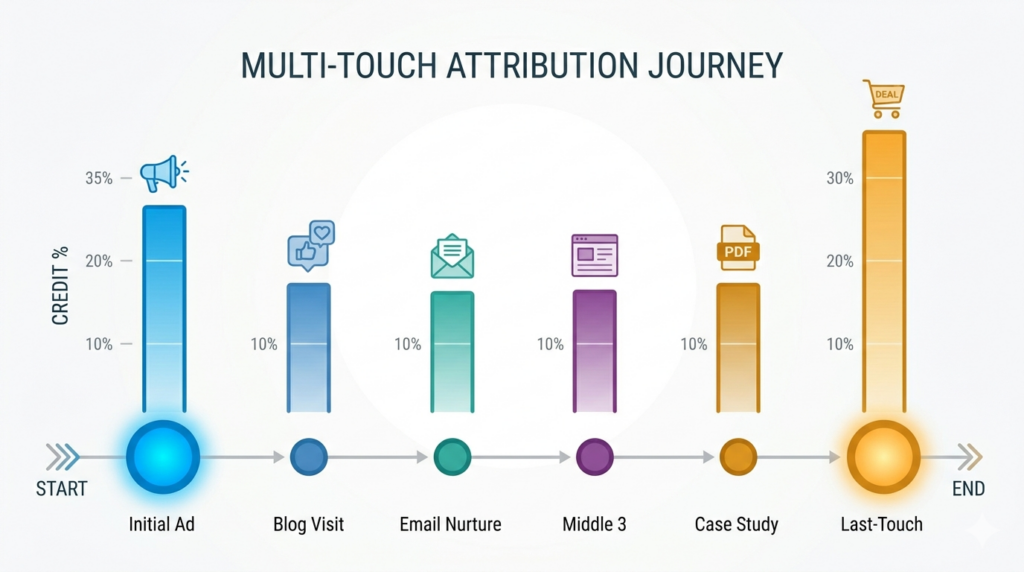
Multi-touch attribution is the only model that attempts to reflect the actual complexity of a B2B buyer journey. A typical enterprise deal involves eight to twelve distinct touchpoints across three to six months. The position-based model (40/20/40) is the most practical starting point for most B2B teams because it acknowledges that both awareness and conversion matter, while distributing residual credit to nurture.
For companies with sufficient data volume — typically 200 or more closed deals with complete interaction histories — HubSpot's data-driven attribution model becomes viable. It removes the human assumption about which touchpoints matter and replaces it with statistical evidence from your actual pipeline. This is the model that most accurately predicts future marketing ROI, but it requires investment in data quality that many teams have not yet made.
Data requirements: what HubSpot needs to attribute accurately
Attribution is only as good as the tracking behind it. HubSpot's attribution reports pull from interaction data stored against contact records. If interactions are not tracked, they cannot be attributed. The common gaps are:
- Offline touchpoints: events, trade shows, phone calls, and in-person meetings are not automatically tracked. They must be logged manually or via workflow from a connected tool.
- Paid media interactions: HubSpot tracks clicks to landing pages, but ad impressions and video views require integration with your ad platforms to be included in attribution.
- First-touch tracking failures: if UTM parameters are not consistent across all campaigns, or if HubSpot's tracking code is not installed on all pages, first-touch data will be incomplete.
- Anonymous interactions: HubSpot cannot attribute interactions from visitors who have not yet converted to contacts. This is a fundamental limitation of cookie-based tracking, not a HubSpot-specific issue.
Choosing the right model for your GTM motion
| GTM motion | Recommended model | Why |
|---|---|---|
| Inbound-led, short cycle (SaaS SMB) | Last touch or time decay | Recent engagement is most predictive of conversion in short cycles |
| Inbound + outbound, mid-market | Position-based (U-shaped) | Balances awareness credit with conversion credit across longer cycles |
| Account-based, enterprise | Data-driven or custom | Enterprise journeys are too complex for simple models; algorithmic weighting reflects actual influence |
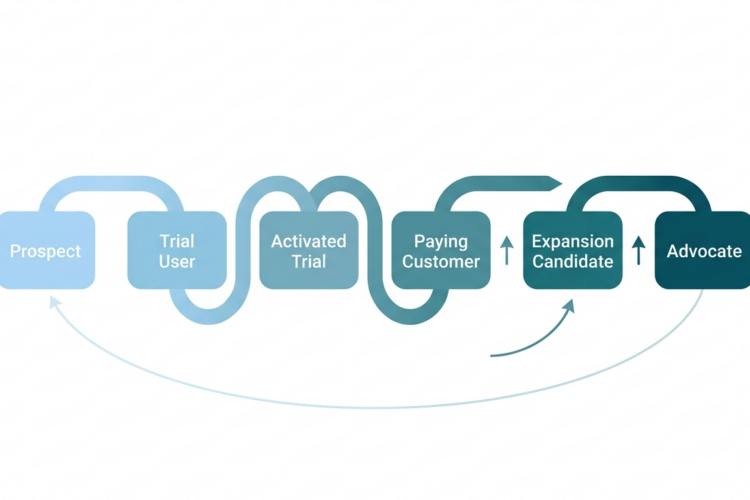
| Product-led growth | Linear or position-based | PLG touchpoints are more evenly distributed; equal weighting avoids undervaluing product engagement |
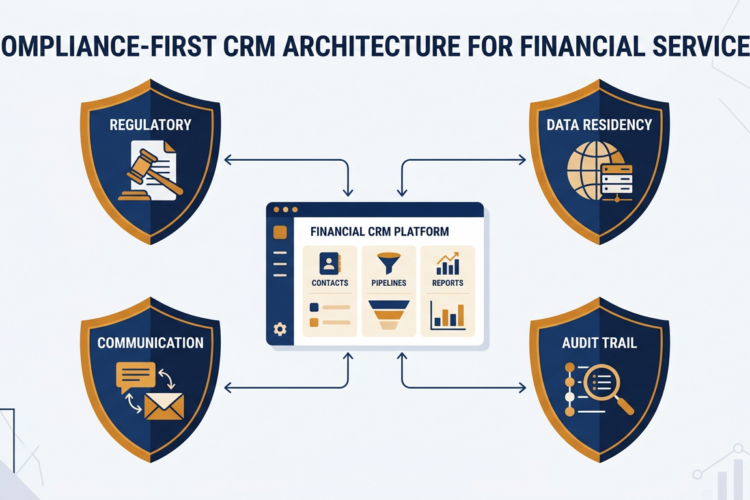
| Financial services / regulated | First touch + last touch in parallel | Compliance constraints limit automation; two simple models run in parallel provide triangulation without complex configuration |
Building your attribution report in HubSpot
HubSpot's attribution reports live in the Reports section under Marketing Analytics. The key steps to build a reliable attribution report are:
- Select your attribution model based on your GTM motion from the framework above. Document your choice and the rationale — this conversation will come up every quarter.
- Define your revenue window. Attribution reports can look at deals closed in a date range or deals created in a date range. These produce very different numbers. Standardise on one definition and use it consistently.
- Set your interaction types. Decide which interactions to include: form submissions, email clicks, page views, meeting bookings. Include only interactions that represent genuine buyer intent — including every page view creates noise that obscures signal.
- Build a comparison view. Run your chosen model alongside first-touch and last-touch for the same period. The gap between them tells you how much your nurture activity is contributing relative to acquisition and conversion.
- Review and reconcile monthly. Attribution reports should be reviewed alongside pipeline reports in your monthly RevOps rhythm. Anomalies — sudden shifts in channel credit, unexpected drops in attributed revenue — usually point to a tracking failure, not a genuine change in channel performance.
The goal of attribution reporting is not to declare a winner among channels. It is to reduce the uncertainty in budget decisions. A well-configured attribution model does not eliminate disagreement — it changes the disagreement from "who deserves credit" to "how should we interpret this data," which is a much more productive conversation.