
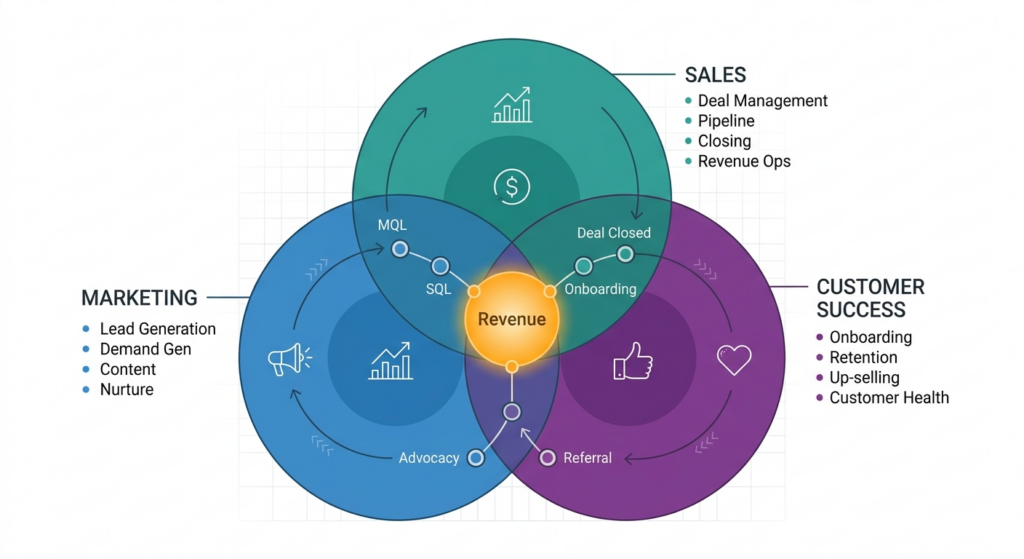
Revenue Operations is not a department. It is an operating model. Here is what that model looks like when it is built properly inside HubSpot — and what breaks when it is not.
- The alignment problem no one talks about honestly
- What RevOps actually means as an operating model
- The four functions of a HubSpot RevOps framework
- Where SaaS and Financial firms diverge
- The three handoffs that determine your revenue efficiency
- How misalignment shows up in your HubSpot data
- Building the framework: a sequenced approach
- The one metric that tells you if your alignment is real
The alignment problem no one talks about honestly
Ask any VP of Sales and VP of Marketing in the same room whether they are aligned. Both will say yes. Then ask them to independently write down their current MQL definition, their pipeline coverage target, and what happens to a lead that goes dark after two sales touches.
The answers will not match. They rarely do.
This is not a people problem. It is a systems problem. When Marketing, Sales, and Service operate inside the same HubSpot portal but with different data definitions, different pipeline views, and different interpretations of what a lifecycle stage means — alignment is an illusion maintained by politeness, not by process.
RevOps exists to make alignment structural rather than interpersonal. And HubSpot, when built correctly, is the infrastructure that makes structural alignment possible.
Companies with aligned Revenue Operations functions grow revenue 19% faster and are 15% more profitable than those without, according to research by SiriusDecisions. The mechanism is not culture — it is shared data and shared definitions.
What RevOps actually means as an operating model
Revenue Operations is the function responsible for ensuring that every team involved in generating, retaining, and expanding revenue operates from the same data, the same processes, and the same performance framework.
It is not a rebrand of Sales Ops. It is not a super-admin role for your CRM. It is an operating model with three core responsibilities:
- Systems alignment: one platform, one data model, one source of truth across Marketing, Sales, and Service
- Process alignment: defined handoffs, agreed entry and exit criteria at every stage, documented escalation paths
- Measurement alignment: shared KPIs that cannot be gamed by one team at the expense of another
HubSpot is uniquely positioned to support this model because it is designed as a unified platform — not a collection of integrations pretending to be one system. But that advantage is only realised when the platform is configured to reflect a deliberate operating model, not just the preferences of whoever set it up first.
The four functions of a HubSpot RevOps framework
A complete RevOps framework in HubSpot spans four functions. Each has a distinct role and a distinct failure mode.
In a mature RevOps organisation, these four functions share a single operating rhythm: weekly pipeline reviews using shared HubSpot dashboards, monthly attribution reconciliation, and quarterly data governance audits. The platform does not manage itself — but it should make managing it systematic.
Where SaaS and Financial firms diverge
The RevOps framework is consistent across industries. The configuration priorities are not.
SaaS companies
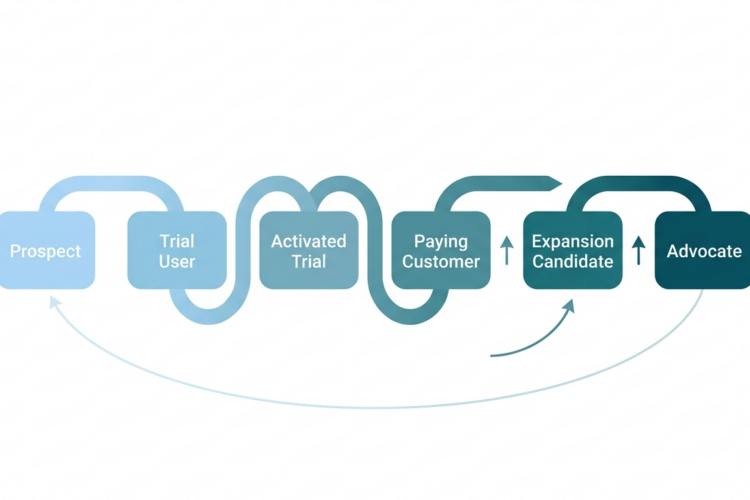
SaaS RevOps in HubSpot is dominated by the product-led growth motion. Trials, freemium users, and self-serve accounts create a high-volume, low-touch pipeline that must coexist with a traditional sales-assisted motion for enterprise deals. The critical challenge is lifecycle architecture: how do you track a user who signs up for a free trial, upgrades to paid, and then becomes an expansion opportunity — all inside one unified contact and company record?
HubSpot handles this well when custom lifecycle stages and product usage data (synced via API or Operations Hub) are built into the CRM model from the start. It handles it poorly when Sales and Marketing are using native lifecycle stages that were never designed for a PLG motion.
Financial services firms
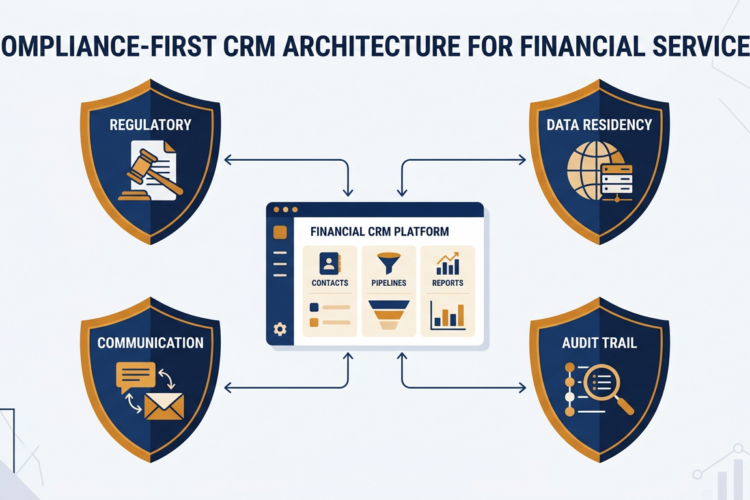
Financial services RevOps faces a different constraint: compliance. Lead handling, communication logging, and data residency requirements mean that the automation-first approach common in SaaS is often not appropriate. In wealth management, private equity, and financial advisory firms, the CRM is frequently used as an audit trail as much as a sales tool.
HubSpot's strength here is its Communication Subscriptions framework and its native activity logging — but these must be configured deliberately. A financial services firm that builds HubSpot like a SaaS company will create compliance exposure. The RevOps framework must account for regulatory constraints at the data model level, not as an afterthought.
The right RevOps framework is industry-agnostic in principle but industry-specific in execution. The four functions are the same. The configuration priorities, governance requirements, and measurement frameworks differ significantly between SaaS and regulated industries like Financial Services.
The three handoffs that determine your revenue efficiency
Most revenue leakage in a scaling company does not happen inside a single team. It happens at the transitions between teams. There are three critical handoffs in every B2B revenue model, and each one must be explicitly designed in HubSpot.
How misalignment shows up in your HubSpot data
Misalignment is not invisible. It leaves specific fingerprints in your CRM data. Here is what to look for:
| What you see in HubSpot | What it actually means |
|---|---|
| High MQL volume, low SQL conversion rate | Marketing and Sales have different lead quality definitions. MQLs are being passed that Sales does not consider sales-ready. |
| Deals stalling at the same pipeline stage consistently | That stage either has no defined exit criteria, or the criteria exist but are not enforced in HubSpot. |
| Contacts with no owner assigned | Lead routing is either broken or was never built. These contacts are in a black hole — no one is responsible for them. |
| Closed-won deals with no subsequent CS activity | The Sales-to-CS handoff is not happening in HubSpot. Onboarding is being managed outside the CRM. |
| Attribution reports showing 80%+ of revenue as "direct" | Campaign tracking is not configured correctly. Marketing's contribution to revenue is being systematically undercounted. |
Building the framework: a sequenced approach
You cannot build a RevOps framework by starting with a workshop and ending with a deck. It must be built in HubSpot, in sequence, with each layer validated before the next is added.
- Define shared language first. Every team must agree on the definition of Lead, MQL, SQL, Opportunity, Customer, and Churned Customer before any HubSpot property is touched. Document these definitions in writing. They will be referenced every time a dispute arises.
- Build the lifecycle architecture. Using the agreed definitions, configure lifecycle stages in HubSpot with automated entry criteria and manual review points. Test with real records before enabling at scale.
- Design and document all three handoffs. Each handoff becomes a HubSpot workflow with a trigger, required data conditions, notifications, and a task creation step. No handoff should depend on memory or goodwill.
- Build the reporting layer last. Once the data is clean and the processes are running, build shared dashboards that each team reviews in the same rhythm — weekly for pipeline, monthly for attribution, quarterly for lifecycle health.
The most dangerous moment in a RevOps build is when one team gets impatient and starts building their own reports before the shared data model is complete. Once teams have their own dashboards showing different numbers, the political cost of reconciling them is enormous. Standardise the data before you standardise the reports.
The one metric that tells you if your alignment is real
There is a single metric that cuts through all the complexity and tells you whether your RevOps framework is working: marketing-sourced revenue as a percentage of total closed revenue, as reported independently by both Marketing and Sales.
If Marketing's attribution report and Sales' closed-won report produce the same number — or a reconcilable difference — your systems are aligned. If they produce numbers that neither team can explain to the other, you do not have a RevOps framework. You have two teams using the same tool in two different ways.
That single test is worth more than any alignment workshop. Run it monthly. When the numbers diverge, investigate the gap — it will always point to a specific process or data failure you can fix.