
The difference between a metrics-driven revenue team and a reporting-heavy one is not the number of dashboards — it is whether the numbers on those dashboards actually change decisions. Here are the KPIs that do.
- The problem with most RevOps dashboards
- The KPI framework: three tiers of measurement
- Tier 1 — Executive KPIs: what the board wants to see
- Tier 2 — Operational KPIs: what RevOps teams live in
- Tier 3 — Diagnostic KPIs: what breaks before the big numbers do
- Vanity metrics to stop tracking
- Building your KPI dashboards in HubSpot
- The review cadence that makes KPIs actionable
The problem with most RevOps dashboards
Most RevOps teams have too many metrics and too few decisions. A dashboard with forty KPIs is not a performance management tool — it is a reporting artefact. It shows that data exists. It does not show what to do with it.
The KPIs that matter are the ones that, when they move in an unexpected direction, trigger a specific investigation or a specific action. If a metric changes and no one knows what to do about it, that metric does not belong on an executive dashboard. It belongs in a diagnostic view used by the people who can act on it.
The test for any KPI you are considering tracking: if this number dropped 20% next quarter, would you know exactly where to look and what action to take? If the answer is no, the metric is descriptive, not diagnostic — and descriptive metrics do not drive decisions.
The KPI framework: three tiers of measurement
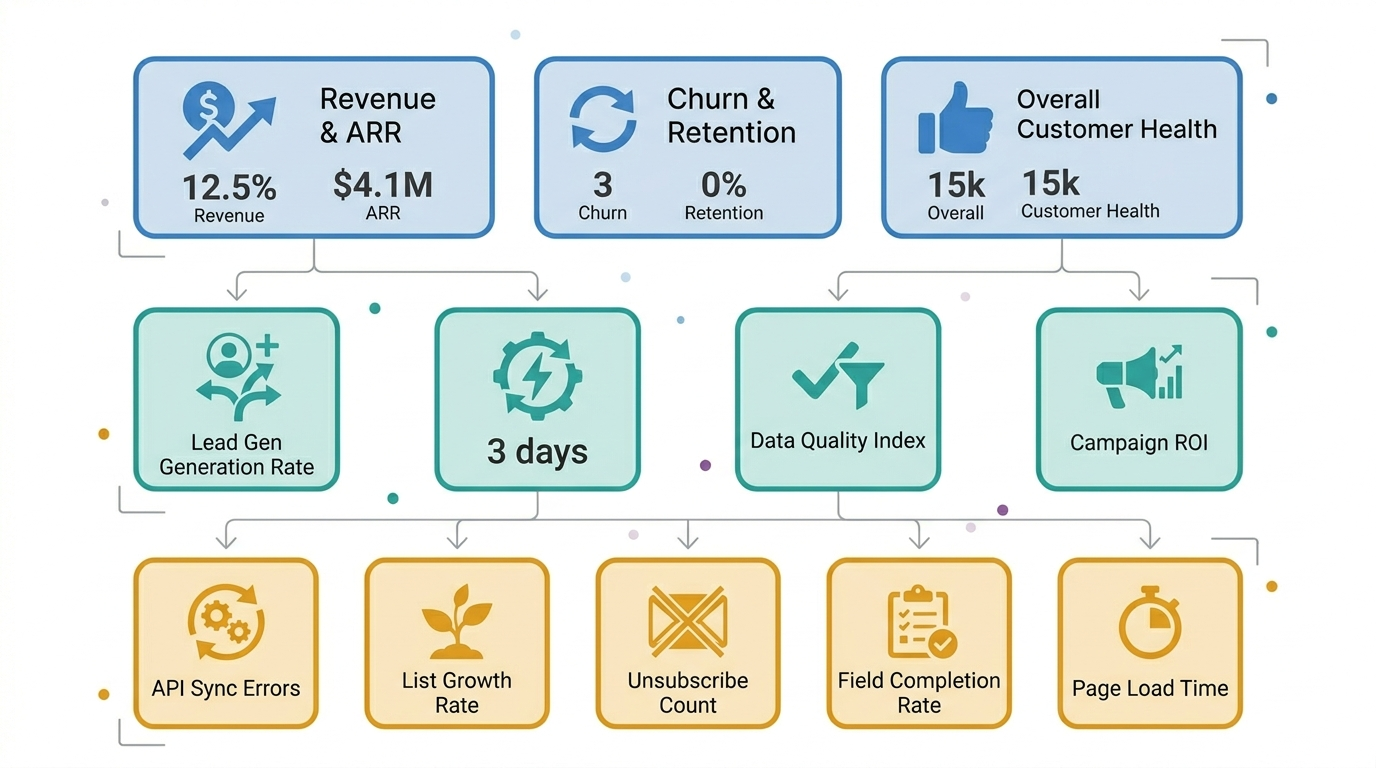
RevOps KPIs should be organised in three tiers, each serving a different audience and operating at a different cadence. The tiers are hierarchical — Tier 1 metrics are composed of Tier 2 metrics, which are composed of Tier 3 metrics. When a Tier 1 metric degrades, you investigate Tier 2. When a Tier 2 metric degrades, you investigate Tier 3.
- Tier 1 — Executive KPIs: reviewed in board and leadership meetings. Monthly and quarterly cadence. Represent the health of the revenue engine as a whole.
- Tier 2 — Operational KPIs: reviewed by RevOps, Sales, and Marketing leadership. Weekly cadence. Represent the efficiency of each stage in the revenue process.
- Tier 3 — Diagnostic KPIs: reviewed by RevOps practitioners. Daily or continuous monitoring. Represent the leading indicators that predict Tier 1 and Tier 2 degradation before it becomes visible.
Tier 1 — Executive KPIs: what the board wants to see
Tier 2 — Operational KPIs: what RevOps teams live in
Tier 3 — Diagnostic KPIs: what breaks before the big numbers do
Vanity metrics to stop tracking
| Metric teams track | Why it is a vanity metric | What to track instead |
|---|---|---|
| Total number of MQLs | Volume without quality. High MQL counts with low SQL conversion means Marketing is generating noise, not pipeline. | MQL-to-SQL conversion rate |
| Email open rate | Rendered meaningless by Apple MPP. Open rate now measures email deliverability, not engagement. | Click-to-open rate and meeting booking rate |
| Number of activities logged | Measures rep compliance with logging rules, not actual selling activity or pipeline progression. | Activities per deal advancing to next stage |
| Website sessions | Traffic without intent. A spike in sessions that does not produce form fills or demo requests is not a revenue signal. | Qualified session-to-conversion rate |
| Social media followers | Audience size is not pipeline. Unless followers are being converted to contacts and tracked through the funnel, follower count is decoration. | Social-sourced contact and MQL volume |
Building your KPI dashboards in HubSpot
HubSpot's dashboard builder supports all three tiers of the KPI framework described above, but requires deliberate architecture to be useful rather than just comprehensive. The practical guidance:
- One dashboard per audience tier. An executive dashboard, an operational dashboard, and a diagnostic dashboard — each with no more than eight to ten metrics. Resist the temptation to put everything in one view.
- Use comparison periods by default. Every metric on an executive dashboard should show current period vs. prior period. A number in isolation is not a signal. A number relative to its trend is.
- Set targets for every Tier 1 and Tier 2 metric. HubSpot's goal tracking feature allows you to set targets against which actuals are displayed. Without a target, a KPI is just a number — it cannot tell you whether performance is acceptable.
- Share dashboards, not exports. Every team member who needs to see a KPI should have access to the live HubSpot dashboard. A weekly PDF export is a document of record, not a decision-making tool.
The review cadence that makes KPIs actionable
KPIs only drive decisions if they are reviewed in a structured cadence with clear ownership and a defined action protocol. The review structure that works for scaling RevOps organisations:
- Daily (Tier 3 only): automated Slack or email alerts when diagnostic KPIs breach defined thresholds. No meeting required — alerts trigger investigation by the relevant owner.
- Weekly (Tier 2): thirty-minute pipeline review with Sales and Marketing leadership. Focus on stage conversion rates, lead response time, and pipeline coverage. Decisions made in the meeting, not after it.
- Monthly (Tier 1 + Tier 2): sixty-minute cross-functional review covering revenue attainment, win rate, CAC, and attribution. Includes a five-minute diagnostic review — any Tier 3 anomalies from the past month that need explanation.
- Quarterly (all tiers): full RevOps health review including KPI target setting for the next quarter, workflow audit, and data quality assessment. The meeting that ensures your measurement framework stays current with your business model.
The most common failure in RevOps KPI programs is not choosing the wrong metrics — it is reviewing the right metrics without a clear protocol for what happens when they move. Every KPI on your executive dashboard should have a documented response playbook: if this metric drops below X, these are the three things we investigate first.