
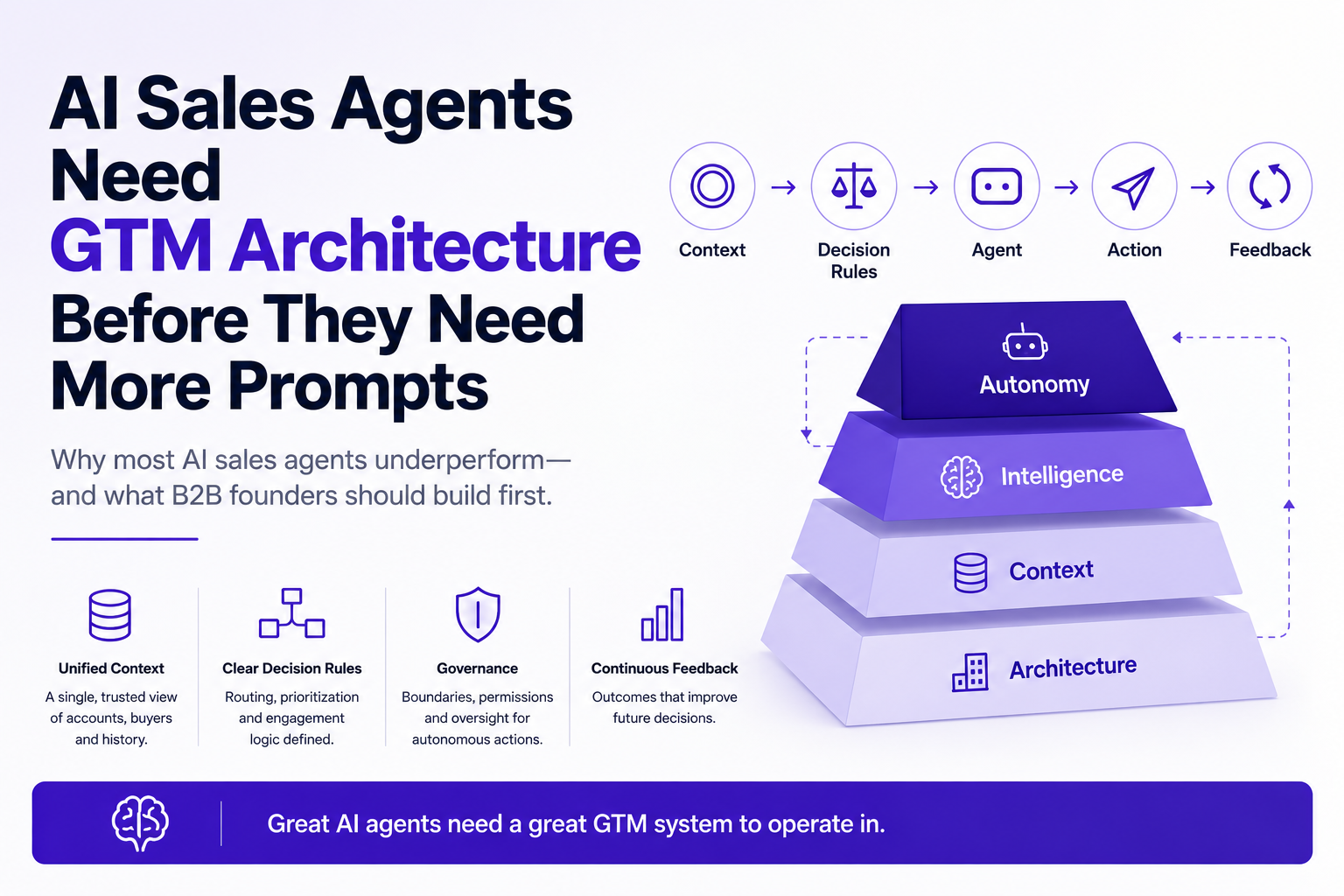
AI Sales Agents Need GTM Architecture Before They Need More Prompts
Why most AI sales agents underperform — and what B2B founders should build first.
and Processes
You bought an AI SDR.
Connected it to your CRM.
Gave it access to thousands of accounts.
Three weeks later, it is emailing existing customers, routing leads to the wrong reps, referencing outdated information, and confidently personalizing outreach using incomplete CRM data.
So the team starts tweaking prompts. New instructions. More context. Different models. Another AI tool.
But the AI may not be the real problem. Your GTM architecture is.
They automate the consequences.
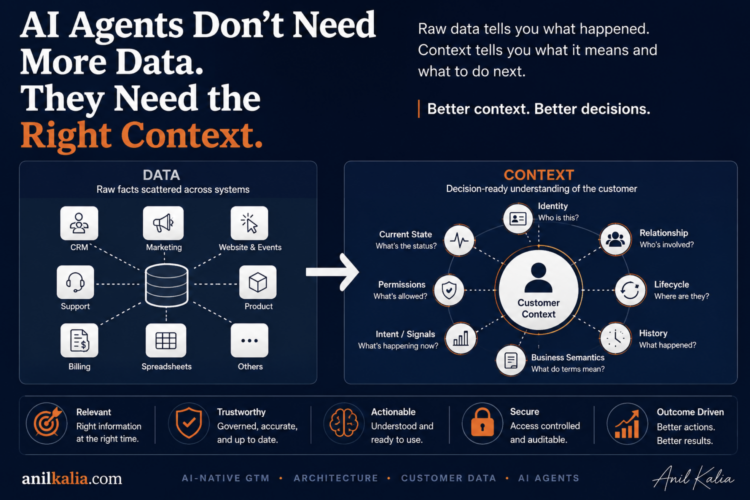
The Real Problem: AI Agents Don’t Lack Intelligence. They Lack Context.
A prospect submits a demo request.
The AI agent may receive a contact record, company information and a handful of form fields.
But that is not enough information to make a reliable GTM decision.
01 — Signal
Something happens.
Demo request, intent signal, product activity, email engagement or another commercial event.
02 — What the Agent Sees
Contact information
Company information
Form data
03 — Context the Decision Needs
- Account status
- Open opportunities
- Buying committee
- Engagement history
- Account ownership
- Lifecycle stage
- Customer history
04 — Decision
Route · Engage · Nurture · Suppress · Escalate
05 — Outcome
Right action.
Right time.
Right owner.
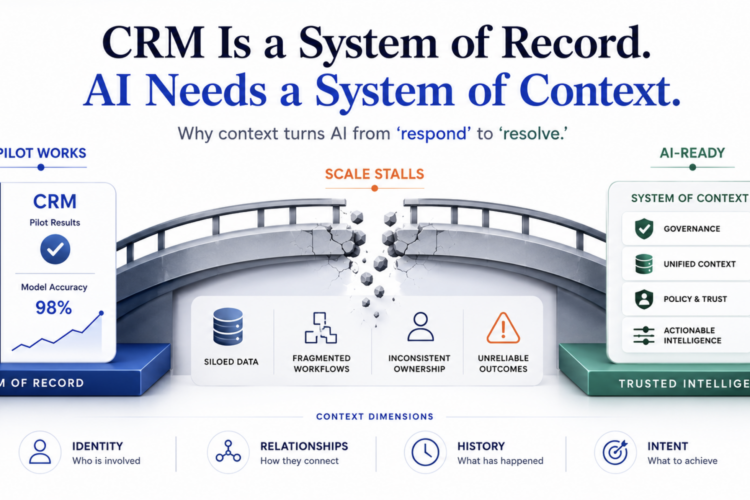
The CRM record is data. The information required to make the right decision is context.
Humans have traditionally filled this gap manually. A salesperson checks the CRM, previous conversations, account ownership, engagement history and other systems before deciding what to do.
An autonomous agent cannot depend on someone manually reconstructing that story every time.
The story has to exist inside the architecture.
Why Most AI Sales Agents Underperform
When an AI sales agent produces weak results, teams usually look at the model or prompt first.
But many failures begin much earlier.
1. Fragmented Context
Customer information is scattered across systems with no single source of truth. The agent sees pieces, not the full picture.
2. Undefined Decision Rules
No clear rules for routing, prioritization, qualification or engagement. The agent guesses because the system does not tell it.
3. No Governance or Feedback
No boundaries. No oversight. No feedback loop. The agent cannot learn what good looks like — or what it is allowed to do.
The AI-Ready GTM Architecture — The Right Order
Most organizations are currently deploying AI like this:
CRM → AI Agent → Action
It looks simple.
It also hides almost every important GTM decision.
A stronger AI-native GTM architecture adds the layers autonomous decision-making actually requires.
1. Signals
Intent, behavior, firmographics, engagement and other inputs
2. Context
Unified account view, relationships, history, status and lifecycle
3. Intelligence
Scoring, propensity, next-best action and predictions
4. Decision
Routing, prioritization, qualification and playbooks
5. Action
Outreach, tasks, workflows and system updates
6. Feedback
Outcomes, results, learning and continuous improvement
What is happening?
Website behavior, demo requests, email engagement, product usage, intent signals, job changes, funding events and CRM activity tell the system something has changed.
What does it mean?
Account identity, ICP fit, buying committees, lifecycle stage, opportunity history, existing ownership and customer status turn isolated signals into a commercial story.
This may be one of the most important layers in an AI-native GTM architecture.
What should we infer?
AI can now interpret reliable context through scoring, prediction, prioritization, risk analysis and next-best-action reasoning.
Notice the order.
AI is not layer one.
What should happen?
Route the account. Add it to an ABM motion. Nurture the prospect. Escalate the opportunity. Suppress an existing customer from prospecting.
This is where GTM architecture turns intelligence into operating logic.
Now the agent acts.
The agent researches, drafts, routes, updates, notifies or executes the approved action.
The action is the visible part of AI.
Everything before it determines whether that action is useful.
What happened?
Did the prospect respond? Did the opportunity advance? Was the account routed correctly? Did the recommendation improve conversion?
Those outcomes should return to the system.
Prompt Engineering Is Downstream of Architecture
Imagine giving an AI sales agent this instruction:
It sounds like a good prompt.
But the prompt silently assumes your organization already knows what defines a high-value account.
It assumes the system knows which account record is authoritative, how account hierarchies work, what counts as intent, who belongs to the buying committee, whether an opportunity already exists, who owns the account and what action is permitted.
The prompt is not solving those questions.
It is assuming they have already been solved.
That is why prompt engineering is downstream of GTM architecture.
5 Questions Every Founder Should Ask
Before buying or scaling an AI sales agent, answer these honestly.
Do we have a single, trusted view of our accounts and buying committees?
Are our lifecycle stages, routing rules and ownership clearly defined?
Can our systems provide real-time context across the full customer journey?
Do AI agents have clear guardrails, permissions and escalation rules?
Can we measure outcomes — and learn from them — over time?
The Competitive Advantage Isn’t the Agent
Your competitors can buy the same AI agents.
They can use the same foundation models.
They can purchase similar enrichment data and connect the same CRM.
They can even copy similar prompts.
What they cannot easily copy is your customer context, GTM data, operating model, decision logic, workflows and institutional knowledge.
As access to AI becomes universal, the quality of the architecture surrounding AI becomes the differentiator.
AI-GTM Readiness Framework
Use these six areas to evaluate how AI-ready your GTM architecture is.
Do you have a unified, trusted view of accounts, contacts, relationships and history?
Are routing, scoring, qualification and lifecycle rules documented and machine-readable?
Is your data accurate, complete, consistent and connected across systems?
Do you have permissions, guardrails, auditability and oversight for autonomous actions?
Are decision boundaries, escalation rules and human-in-the-loop points clearly defined?
Are outcomes captured and fed back into the system to improve future decisions?
Great AI Agents Need a Great GTM System to Operate In
AI sales agents are going to become a normal part of B2B go-to-market.
Research agents. Prospecting agents. Qualification agents. Routing agents. Pipeline agents. Expansion agents.
Eventually, companies may have many specialized agents operating across the customer lifecycle.
But adding more agents does not automatically create a better GTM organization.
The companies that benefit most will first answer a more fundamental question:
Context second.
Intelligence third.
Autonomy last.
Because AI sales agents do not need another collection of clever prompts.
They need a GTM system worth operating.
What’s Breaking in Your GTM Architecture?
AI agents often expose problems that already exist across CRM, data, lifecycle, routing, ownership and automation.
If you are working through one of these challenges, share the scenario with me. I’m always interested in understanding how teams are approaching AI-native GTM architecture — and where the architecture starts breaking down.
Share Your GTM Problem →A discussion prompt — not a consulting offer.