

The AI-Ready Customer Data Architecture: What GTM Teams Actually Need
AI agents don’t need more customer data. They need the right customer data — usable, trustworthy and contextual — at the moment a decision has to be made.
AI agents don’t need more customer data. They need the right customer data — usable, trustworthy and contextual — at the moment a decision has to be made.
Most GTM teams don’t have an AI data problem because they lack data.
They have one because their customer data was never designed for machines that need to reason and act.
For years, the customer-data stack was built around a familiar set of requirements: store records in CRM, capture campaign engagement, push product events into analytics, consolidate reporting in a warehouse, synchronize selected attributes back to operational tools, and give humans dashboards from which they could interpret what was happening.
That architecture can work extremely well for reporting and automation.
AI agents change the requirement.
An agent doesn’t simply retrieve a field and display it. It may need to decide whether an inbound account should be routed, whether an existing customer should receive a sales message, whether a renewal signal is important, whether a pricing request can be answered automatically, or whether a situation should be escalated to a human.
Those decisions require more than access.
They require identity, relationships, freshness, semantics, source authority, policy, provenance and customer context.
This is why “clean the CRM before using AI” is good advice — but incomplete advice.
Clean records are necessary. They are not the architecture.
The goal is not to make every customer record available to AI. The goal is to make the right customer data understandable, trustworthy and usable at the moment a decision needs to be made.
That is what I mean by AI-ready customer data.
1. Customer Data Was Designed for Humans and Workflows
Look at the way most GTM systems evolved.
CRM was designed to help sales teams manage accounts, contacts, opportunities, activities and forecasts.
Marketing automation was designed to manage audiences, campaigns, forms, scoring and nurture.
Support systems were designed around cases, conversations, queues and service history.
Billing systems were designed around subscriptions, invoices, payments and entitlements.
Product analytics was designed to capture events and understand usage.
Warehouses and lakehouses became places to consolidate data for analysis, modeling and increasingly activation.
None of those systems is inherently wrong for AI.
The problem is that humans have historically supplied a large amount of invisible context.
An experienced account executive sees an opportunity marked “Negotiation” and knows the field is two weeks out of date because they spoke to procurement yesterday.
A customer success manager sees falling usage and knows it is expected because the customer is between implementation phases.
A RevOps leader sees two contacts from the same domain and recognizes that they belong to a strategic parent account even though the CRM hierarchy is incomplete.
A marketing operations specialist knows that “MQL” means something different in one business unit than another.
Humans fill gaps with organizational memory.
Agents cannot safely depend on that invisible layer.
If business meaning lives in people’s heads, Slack threads, spreadsheet conventions and undocumented workflow logic, an AI agent receives records without necessarily receiving the meaning required to use them.
That changes the architecture question.
Traditional customer data asks: What do we know about this record?
AI-ready customer data asks: What does the business currently know about this customer situation, how trustworthy is that knowledge, and what may this agent do with it?
Those are very different requirements.
- Reports and dashboards
- Human interpretation fills gaps
- Often batch refreshed
- Record-centric
- Field definitions
- Access control
- Historical consolidation
- Decisions and actions
- Meaning explicit for humans + machines
- Freshness tied to use case
- Entity + relationship + context
- Semantic definitions
- Access + action governance
- Current state + provenance
2. Why “Clean CRM Data” Is No Longer Enough
I am strongly in favor of CRM data quality.
Duplicates, incomplete ownership, stale lifecycle fields, broken associations and inconsistent picklists create problems long before AI arrives.
But imagine that your CRM is perfectly clean.
You still may not know:
- whether the product user is the same person as the marketing contact;
- whether two subsidiaries belong to the same commercial parent;
- whether an account’s usage changed in the last hour;
- whether an open support escalation should suppress an upsell action;
- whether “active customer” has the same meaning in CRM and billing;
- whether a churn-risk value is a fact, a calculation or a model inference;
- whether the agent is allowed to use an internal note;
- whether the agent may read pricing information but not send it externally;
- which source wins when two systems disagree.
These are not conventional CRM-cleanup questions.
They are architecture questions.
AI readiness therefore has to be evaluated against the decision or use case, not as a universal badge attached to a database. Gartner’s current guidance makes a similar point: data readiness depends on the specific AI use case, including its semantic, quality, trust, observability and governance requirements.
For GTM teams, that means there is no useful project called: “Make all customer data AI-ready.”
A better project is: “Make the customer data required for this decision AI-ready.”
That sounds like a small wording change. Architecturally, it is enormous.
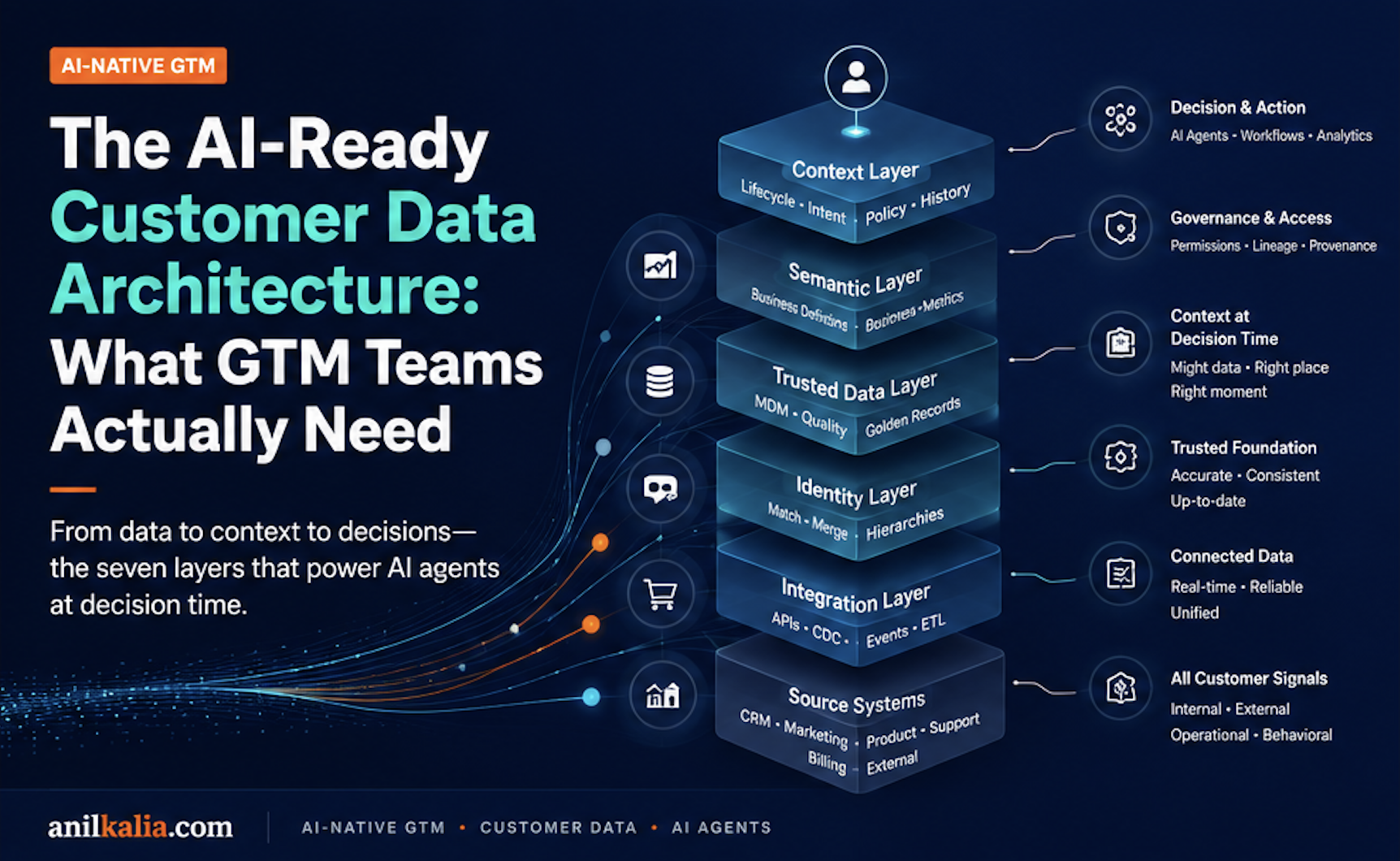
3. The Seven Layers of AI-Ready Customer Data
I find it useful to separate AI-ready customer data into seven layers.
Not because every company needs seven new platforms. It doesn’t.
The layers represent responsibilities. One platform may perform several of them. In another architecture, each responsibility may be distributed across different systems.
What matters is that the responsibilities exist.
Layer 1 — Source Systems
This is where customer reality is recorded.
CRM may own account, contact and opportunity state. Marketing systems may own campaign interactions, forms and subscriptions. Product systems may own usage events. Support may own service conversations and escalations. Billing may own subscription, invoice and entitlement state. External sources may provide enrichment or intent.
The first mistake is pretending one of these systems contains the whole customer. It usually doesn’t.
The second mistake is treating every source as equally authoritative for every attribute. It shouldn’t be.
Source authority needs to be explicit.
Layer 2 — Integration
Customer data has to move, synchronize or become retrievable across boundaries.
That can involve APIs, webhooks, CDC, event streams, ETL/ELT, reverse ETL, federation or direct query patterns.
The architecture decision should depend on the use case.
A nightly sync may be perfectly adequate for a monthly territory report. It may be completely inadequate for an agent deciding whether to contact an account that opened a critical support case ten minutes ago.
Integration is therefore not simply about connectivity.
It establishes the latency contract between business reality and the systems making decisions.
Layer 3 — Identity
This is where AI-ready customer architecture becomes much more than integration.
A CRM contact, product user, support user, billing contact and marketing profile may all represent the same person.
An account may have subsidiaries, regional entities, domains, brands and a global parent.
If identity is not resolved, the agent sees multiple realities.
It may prospect an existing customer because the marketing profile is not linked to the customer account. It may miss buying-group activity because contacts are distributed across duplicate companies. It may personalize from the wrong relationship because account hierarchy is incomplete.
Identity resolution turns records into entities.
Relationship modeling turns entities into a business graph.
For AI agents, both are foundational.
Layer 4 — Trusted Data
Identity alone does not make the data trustworthy.
This layer covers data quality, master-data rules, golden-record logic, source authority, validation and observability.
“Golden record” is sometimes interpreted as a magical single copy of everything. That is not how I would design it.
A useful mastered customer entity can still reference attributes maintained by authoritative operational systems.
Billing may remain authoritative for subscription state. CRM may remain authoritative for opportunity ownership. Product systems may remain authoritative for usage.
The architecture needs to know which source is trusted for which decision.
That is more useful than forcing every attribute into one universal record.
Layer 5 — Semantic Layer
This is one of the most important layers for AI and one of the easiest to underestimate.
What is an active customer? What is a qualified account? What does renewal risk mean? What is enterprise? What counts as product adoption? When should an opportunity be considered open?
Humans often navigate inconsistent definitions because they know which dashboard, team or field is being discussed.
An autonomous agent needs the business meaning to be explicit.
Salesforce’s 2026 discussion of semantic layers makes this point directly: data platforms built for human analysts could rely on people to fill in meaning, while agents need that meaning to be governed and machine-readable.
This is why AI-ready data architecture is partly semantic architecture.
The agent does not just need a value. It needs to know what the value means.
Layer 6 — Context Layer
Semantics gives data meaning. Context gives it situational relevance.
The context layer assembles the pieces that matter to the decision: identity, relationships, lifecycle, history, current signals, commercial state, service state, policy, and possibly conversation memory.
This layer does not have to be a permanent physical database.
Context may be assembled dynamically from governed sources.
The objective is not to duplicate every customer record.
The objective is to create the minimum trustworthy representation of the customer situation that the decision requires.
This connects directly to the argument in Article #3: customer data is not customer context.
Layer 7 — Governance and Access
The final layer determines what can be discovered, retrieved, interpreted and acted upon.
That includes permissions, lineage, provenance, sensitivity, auditability and action controls.
Traditional governance often focuses on who can access data.
Agentic systems add another question: What is the agent allowed to do because of that data?
An agent may be allowed to read an opportunity amount but not disclose it externally. It may be allowed to summarize a support case but not close it. It may be allowed to recommend a discount but not approve one.
Read access and action authority are different controls.
AI-ready architecture has to recognize both.
4. Customer 360 Is Not the Same as AI-Ready Customer Data
“Customer 360” has been one of the dominant ideas in customer-data architecture for years.
The objective is valuable: unify fragmented customer information into a more complete profile.
But a unified profile is not automatically decision-ready context.
A Customer 360 may be refreshed in batches. It may contain excellent historical consolidation but weak real-time state. It may unify records without standardizing business meaning. It may support segmentation but not expose provenance. It may enforce data access without defining what an agent may do after retrieving the data. It may be designed primarily for human consumption.
AI-ready customer data extends the requirement.
Instead of asking only: Do we have a unified customer profile?
we also ask:
Is the identity trustworthy?
Are the relationships understood?
Is the state fresh enough for this decision?
Are business definitions machine-readable?
Can the system explain where important context came from?
Can policy control both access and action?
Can context be assembled when the decision is being made?
Customer 360 is still useful. It simply isn’t the finish line.
| Customer 360 | AI-Ready Customer Data |
|---|---|
| Unified profile | Decision-ready context |
| Primarily human consumption | Human + machine consumption |
| Often batch refreshed | Freshness tied to use case |
| Record-centric | Entity + relationship + context |
| Field definitions | Semantic definitions |
| Access control | Access + action governance |
| Historical consolidation | Current state + provenance |
| Reporting-oriented | Analytics + workflow + agent-ready |
5. Identity Becomes Non-Negotiable
AI makes weak identity architecture much more dangerous because agents can operationalize the mistake.
A duplicate contact in a report is annoying.
A duplicate identity used by an autonomous agent can produce an external action.
Imagine the same person exists as a CRM contact, a webinar attendee, a product administrator, a support requester, and a billing contact.
If those identities are disconnected, an agent may interpret each interaction independently.
Now imagine the same company exists as a regional CRM account, a global parent, a billing entity, a product workspace, and several web domains.
The agent needs more than deduplication. It needs relationships.
This is why I think identity architecture for AI should have three distinct responsibilities:
Match — determine which records likely represent the same real-world entity.
Merge or master — establish the trusted representation and source authority.
Relate — model how people, accounts, workspaces, subsidiaries and owners connect.
The third step is frequently the one that creates decision value.
A B2B agent does not only need to know who a person is. It may need to know that the person belongs to a subsidiary of a strategic global account, that another stakeholder is already engaged with Sales, and that the account is approaching renewal.
Identity gives us the entity. Relationships give us the situation.
Merge / Master
Hierarchy
6. Business Semantics Become Part of the Architecture
Consider four systems.
CRM says: Lifecycle = Customer
The warehouse says: Active_User = FALSE
Billing says: Subscription_Status = Active
Support says: Escalation = Critical
Which one describes the customer?
All of them.
But none of them independently tells an agent what the business should do next.
The problem is not necessarily data quality. The fields may all be correct.
The problem is that each system describes a different dimension of the relationship.
A semantic layer helps define concepts that can be consistently interpreted across systems and consumers.
For example, Active Customer might mean a customer with a current commercial entitlement, regardless of recent product usage. Product Active might mean a customer exceeding a defined usage threshold within a specified period. At Risk might require a combination of product, support, commercial and relationship signals.
These definitions should not be hidden inside a dashboard formula if agents are expected to reason over them.
Business semantics needs to become shared infrastructure.
That does not mean every organization needs a knowledge graph tomorrow.
It means the important business concepts used in automated decisions need explicit definitions, owners and logic.
7. Freshness Should Be Defined by the Decision
“Real-time data” sounds like an obvious requirement for AI. It isn’t.
Some decisions need real-time information. Others don’t.
An agent responding to a pricing request may need the current opportunity owner and latest commercial status.
A service agent deciding whether an entitlement is valid may need near-real-time billing state.
A churn model may work with daily product aggregates.
An account-research agent may be perfectly effective with firmographic enrichment updated weekly.
Trying to make everything real time can add cost and architectural complexity without improving the decision.
The better question is: How stale can this data become before the decision becomes unsafe or materially worse?
That gives us a useful freshness model:
Real-time required — the decision is highly sensitive to current state.
Near-real-time preferred — delay reduces quality but does not immediately invalidate the decision.
Batch is sufficient — the underlying business state changes slowly enough that periodic refresh is appropriate.
IBM’s 2026 AI-ready data discussion emphasizes real-time, contextualized and governed data for agentic use cases. The important design lesson is not that every table must stream. It is that the freshness of context has to match the action being taken.
Freshness is a business requirement before it is a streaming-technology requirement.
8. The AI-Ready Data Contract
Data contracts are often discussed between data producers and consumers.
For agentic GTM systems, I would extend the idea.
Every customer attribute or business concept that can materially affect an AI decision should have an explicit contract.
At minimum, I want to know:
Definition — What does this attribute mean?
Source of truth — Which system is authoritative?
Owner — Who is accountable for the definition and quality?
Quality expectation — What conditions must the data satisfy?
Freshness requirement — How current must it be for the use case?
Sensitivity — Does it contain restricted, personal or commercially sensitive information?
Allowed consumers — Which users, systems and agents may access it?
Action constraints — What may an agent do based on it?
Provenance — Can we trace the value or inference to its origin?
Consider a field called `renewal_risk`.
Without a contract, the agent sees a value.
With a contract, the architecture can know whether that value was manually entered, calculated from a deterministic rule, predicted by a model, when it was last updated, who owns it, and whether it is safe to use for a customer-facing action.
That is a very different level of trust.
9. What Should Live Where?
AI-ready architecture does not require every capability to move into one platform.
In fact, trying to force all customer-data responsibilities into one system often creates another monolith.
A more useful principle is: Keep operational authority close to the system that owns the business process, while making governed context available to the systems that need to decide.
Transactional sales ownership may remain in CRM.
Master identity may live in MDM, a customer-data layer or a governed warehouse/lakehouse pattern.
Behavioral history may live in the warehouse or lakehouse.
Real-time signals may travel through event infrastructure.
Knowledge may live in a retrieval or knowledge layer.
Business definitions may be maintained in semantic and metadata systems.
Agent runtime context may be assembled dynamically.
Permissions may be enforced across source systems, governance controls and the agent runtime.
The exact vendor stack is secondary. The architecture needs clear responsibility.
This is also why I am skeptical of diagrams that place “AI” as one box connected directly to “all enterprise data.”
The useful work is in the layers between those boxes.
10. A Practical GTM Architecture in Action
Take a generic inbound enterprise request.
Someone submits a high-intent form asking for pricing.
A traditional workflow may create or update the contact, score the lead, route it, notify Sales, and start a sequence.
An AI agent could potentially make the experience more intelligent.
But only if the architecture can answer the right questions first.
Step 1 — Resolve identity
Is this person already known? Which account do they belong to? Is there a parent account? Are there other active stakeholders?
Step 2 — Retrieve current commercial state
Is there an open opportunity? Who owns it? What stage is it actually in? Is a partner involved?
Step 3 — Add customer relationship context
Is this an existing customer? Is renewal approaching? Is there a support escalation? Are there contractual or regional restrictions?
Step 4 — Apply semantics and policy
What qualifies as an enterprise account? What information may this agent disclose? Does this situation require human review?
Step 5 — Make the decision
Start a new sales motion? Route to the existing account team? Provide approved information? Escalate? Do nothing automatically?
Step 6 — Capture the outcome
What action occurred? Was it accepted or overridden? Did a human correct the context? Did the source data need remediation?
That feedback should not disappear. It should improve the architecture.
This is the difference between connecting an agent to CRM and designing a GTM system in which an agent can operate responsibly.
11. AI-Ready Does Not Mean AI-Specific
There is a useful side effect to all of this.
An architecture that improves identity, semantics, lineage, freshness, source authority and governance is not valuable only to AI.
It improves reporting. It improves segmentation. It improves routing. It improves attribution. It improves customer lifecycle management. It improves automation. It improves analytics. It improves migrations and integrations.
In other words, the best AI-readiness work often looks suspiciously like good data architecture.
AI simply raises the cost of leaving the gaps unresolved.
A human analyst may notice a suspicious number and investigate. A workflow may fail loudly. An agent can interpret bad context, make a plausible decision and act at machine speed.
That is why IBM’s current framing around trusted, contextualized and governed data is important: when agents can act, fragmented data is not just an analytics inconvenience. It can become an operational risk.
12. The AI-Ready Customer Data Checklist
Before calling your customer data AI-ready, I would test the architecture against a real decision.
Identity
Can we reliably resolve the person, account and relevant hierarchy?
Relationships
Can we understand the relationships that change the decision?
Source authority
Do we know which system wins for each critical attribute?
Data quality
Are important fields monitored rather than assumed to be correct?
Semantics
Do important business terms have explicit, shared definitions?
Freshness
Is each input current enough for the decision it supports?
Provenance
Can we tell where an important fact, signal, calculation or inference came from?
Permissions
Can we control which context an agent is allowed to retrieve?
Action governance
Can we separately control what the agent may change, send or trigger?
Context assembly
Can the right information be assembled at decision time without dumping the entire customer history into the model?
Observability
Can we see what context influenced the decision?
Feedback
Can corrections and outcomes improve data, rules and future decisions?
If several of these answers are unclear, adding another AI tool will not solve the underlying problem.
Closing: Build for Decisions, Not for Data Volume
For years, customer-data strategy has often been expressed as a consolidation problem.
Bring the data together. Create the profile. Build the 360.
Those goals remain useful.
But AI agents introduce a higher bar.
They need customer data that is not only available but interpretable.
Not only clean but fit for a particular decision.
Not only unified but identity-resolved.
Not only current but current enough.
Not only governed for access but governed for action.
Not only stored but semantically meaningful.
Not only retrieved but accompanied by enough provenance to understand why it should be trusted.
That changes what “AI-ready” should mean for GTM teams.
The goal isn’t to build a special database for AI.
And it isn’t to copy every customer record into a new context platform.
The goal is to build a customer-data architecture in which trusted information can become decision-ready context when humans, workflows or agents need it.
That foundation can support analytics today, automation tomorrow and increasingly autonomous agents after that.
The technology will keep changing.
The architecture requirement will not:
Right identity. Right meaning. Right context. Right controls. Right time.
That is the customer-data foundation AI actually needs.
One question I’d like to leave open
If you are preparing CRM and customer data for AI agents, where is the hardest gap today?
Identity? Semantics? Freshness? Source authority? Permissions? Or assembling context across systems without creating yet another copy of the customer?
That is the architecture conversation I think GTM teams need to have before they scale agents.