
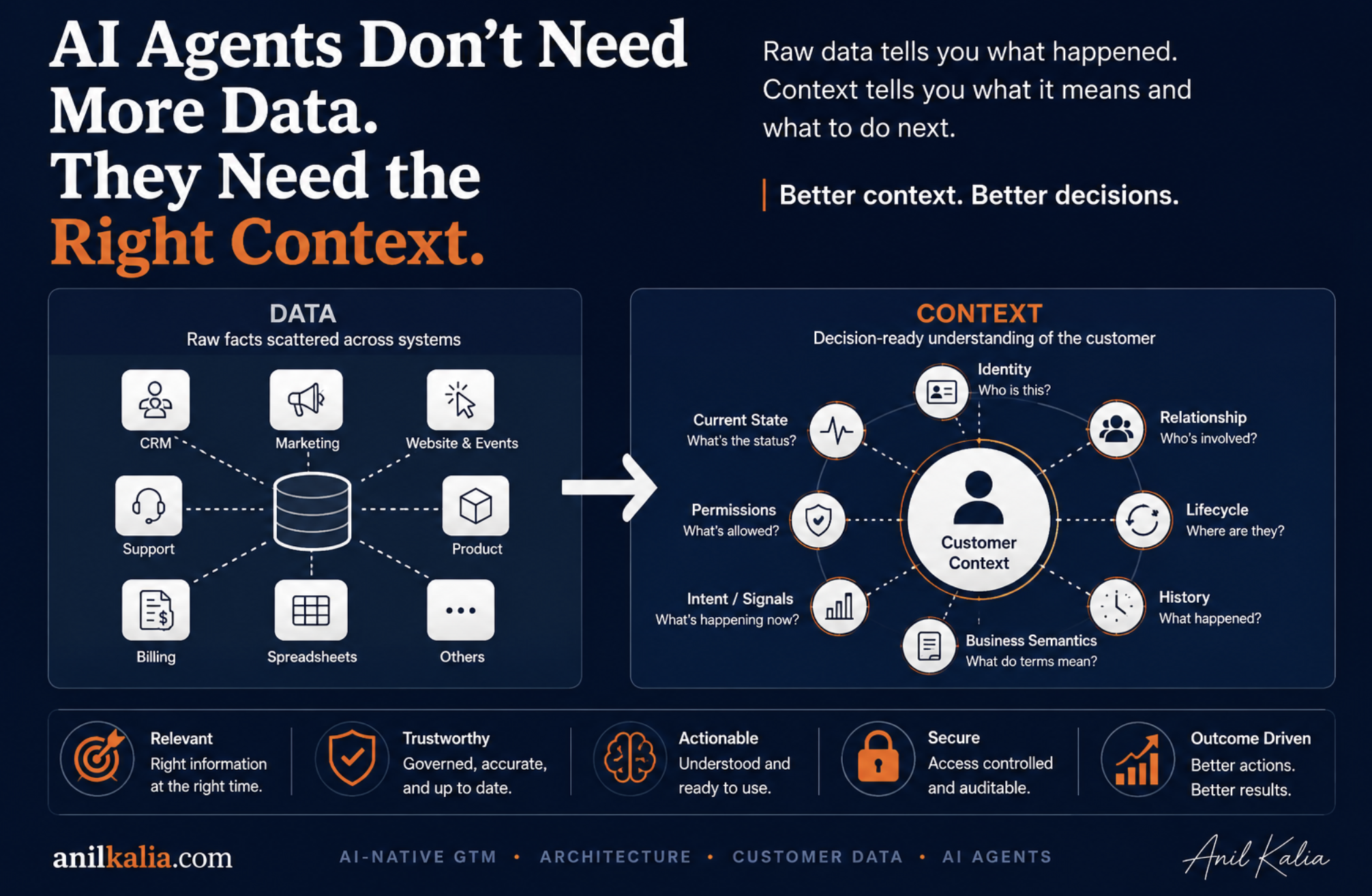
Your AI Agent Has a Customer Context Problem, Not a Prompt Problem
Why better prompts won’t fix an AI agent that doesn’t understand the customer.
Your AI agent gives the wrong answer. So you rewrite the prompt. You add another instruction. You give it a few examples. Maybe you change the model.
The output improves. Then a different customer situation appears—and the agent makes another bad decision.
At some point prompt engineering stops being the real problem, because an agent cannot reason about a customer situation it cannot see.
The agent doesn’t just need customer data. It needs customer context.
We Keep Debugging the Wrong Layer
Consider the architecture behind a basic AI interaction: Request → Prompt → Model → Response.
When something goes wrong, attention naturally goes to the visible parts.
Those are legitimate questions. But enterprise agents operate inside a much larger system.
Customer
Instructions
Reasoning
Output
Sources
Who is this?
Situation
What’s allowed?
Outcome
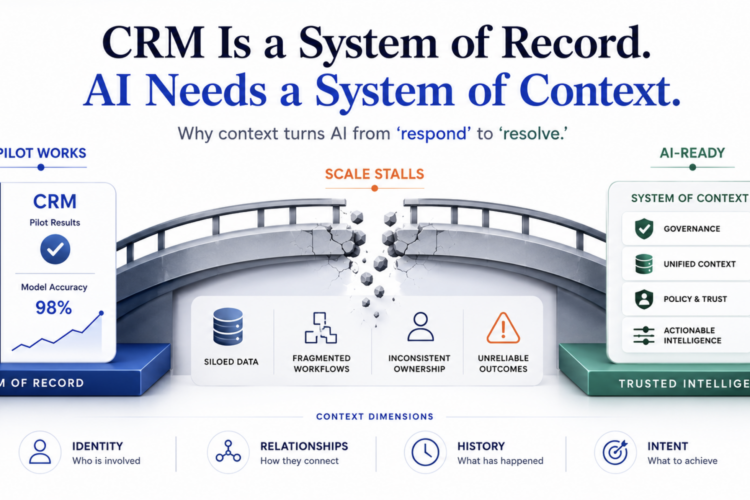
Customer Data Is Not Customer Context
Customer data describes things. Customer context explains what those things mean right now.
| Customer Data | Customer Context |
|---|---|
| Contact + Account | Who this person is and which organization they belong to |
| Opportunity | Whether an active buying process already exists |
| Activities | What has happened recently |
| Product usage | How the customer is actually using the product |
| Support tickets | Whether there is an unresolved relationship issue |
| Web/form activity | What may be happening now |
The Seven Dimensions of Customer Context
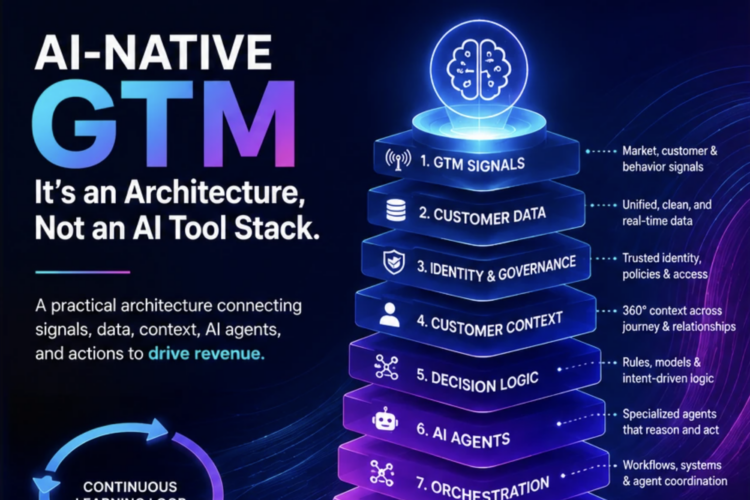
What Customer Context Architecture Actually Looks Like
CRM Access Is Not Context Engineering
CRM is extremely important, but it is usually one participant in the customer-data architecture. Support may know about an escalation while product telemetry shows declining usage and billing knows a renewal is approaching.
The Same Prompt. A Completely Different Decision.
No active opportunity
No prior commercial discussion
Possible action: approved information + normal routing.
Active opportunity
Named owner
Commercial discussion underway
Possible action: route to the account team.
Seven Context Problems That Look Like AI Problems
Read Context and Action Context Are Different
Opportunity history
Product usage
Support interactions
Lifecycle state
Signals and notes
Update CRM
Send external communication
Change stage
Apply commercial terms
Trigger workflows
Policy / deterministic rules / approval where required
A Customer Context Layer Is Not Another Data Copy
Context can be assembled dynamically. CRM can provide opportunity and ownership. MDM can resolve identity. A warehouse can provide product behavior. Support can expose an escalation. Billing can return entitlement. Knowledge can provide policy.
Context Also Needs Provenance
Mature context architecture should distinguish fact, calculation, signal and inference, because all four can appear as context but do not carry the same authority.
The Customer Context Checklist
- Is person/account identity resolved?
- Are important relationships available?
- Is lifecycle state current?
- Are time-sensitive signals fresh?
- Are business definitions consistent?
- Is source authority known when systems conflict?
- Can important context be traced to its source?
- Are permissions enforced?
- Are high-risk writes controlled separately?
- Is irrelevant context filtered?
- Does the outcome feed back into the architecture?
Stop Asking “Is the Prompt Good Enough?”
Prompt engineering isn’t going away. Good instructions, model selection, retrieval and evaluation all matter.
Does this agent have enough trustworthy context to make this decision?
One question I’d like to leave open
If you’re building AI around CRM, customer data or revenue workflows: which piece of customer context has been hardest to make reliable?
Identity? Lifecycle? Relationships? Freshness? Business definitions? Permissions?