What Is AI-Native GTM? It's an Architecture, Not an AI Tool Stack.
AI-native GTM is not about buying more AI tools. It is about designing the revenue architecture that connects signals, customer data, context, decision logic, agents, orchestration, and feedback so AI can make useful decisions inside the real GTM system.
AI-Enabled GTM
AI-Native GTM
Most B2B companies already use AI somewhere in go-to-market.
Sales teams use copilots. Marketing teams generate content. Revenue operations teams automate enrichment and routing. Customer success teams summarize calls. Founders experiment with AI SDRs, research agents, and scoring models.
That does not automatically make the company AI-native.
In many cases, the underlying revenue system has barely changed. The same fragmented customer records remain. The same lifecycle definitions conflict across teams. The same routing logic lives in workflows nobody fully owns. The same handoffs happen between Marketing, Sales, Customer Success, and Finance.
AI simply makes individual steps faster.
Most Companies Are AI-Enabled, Not AI-Native
An AI-enabled GTM organization may have an impressive list of tools. But each tool often operates with a narrow view of the customer and a narrow understanding of what should happen next.
An AI SDR can draft an email. A scoring model can rank an account. A copilot can summarize a call. A workflow can move a lifecycle stage. Those capabilities are useful, but none of them solves the architecture problem by itself.
An AI-native GTM system has to answer a more difficult set of questions:
- What signal actually occurred?
- Which customer, account, opportunity, or buying group does it belong to?
- What does the business already know about that customer?
- Which lifecycle rules, permissions, and commercial constraints apply?
- What action is appropriate now?
- Can an agent take that action autonomously, or should a human approve it?
- Did the action improve the revenue outcome?
Those are architecture questions, not prompting questions.
What AI-Native GTM Actually Means
I use AI-native GTM to describe a go-to-market operating architecture in which AI is designed into the flow of signals, data, decisions, actions, and learning rather than added as a separate productivity layer.
The word native matters. It means the system assumes from the beginning that software agents may research, recommend, route, update, trigger, communicate, and eventually execute parts of the customer journey.
That changes the architecture required underneath them.
If a human salesperson receives incomplete information, they can often reconstruct the missing context by opening five tabs, asking a colleague, reading an old email thread, or simply using judgment. An autonomous system cannot depend on that invisible human repair work.
The context has to be accessible. The decision rules have to be explicit. The permissions have to be enforceable. The outcome has to be measurable.
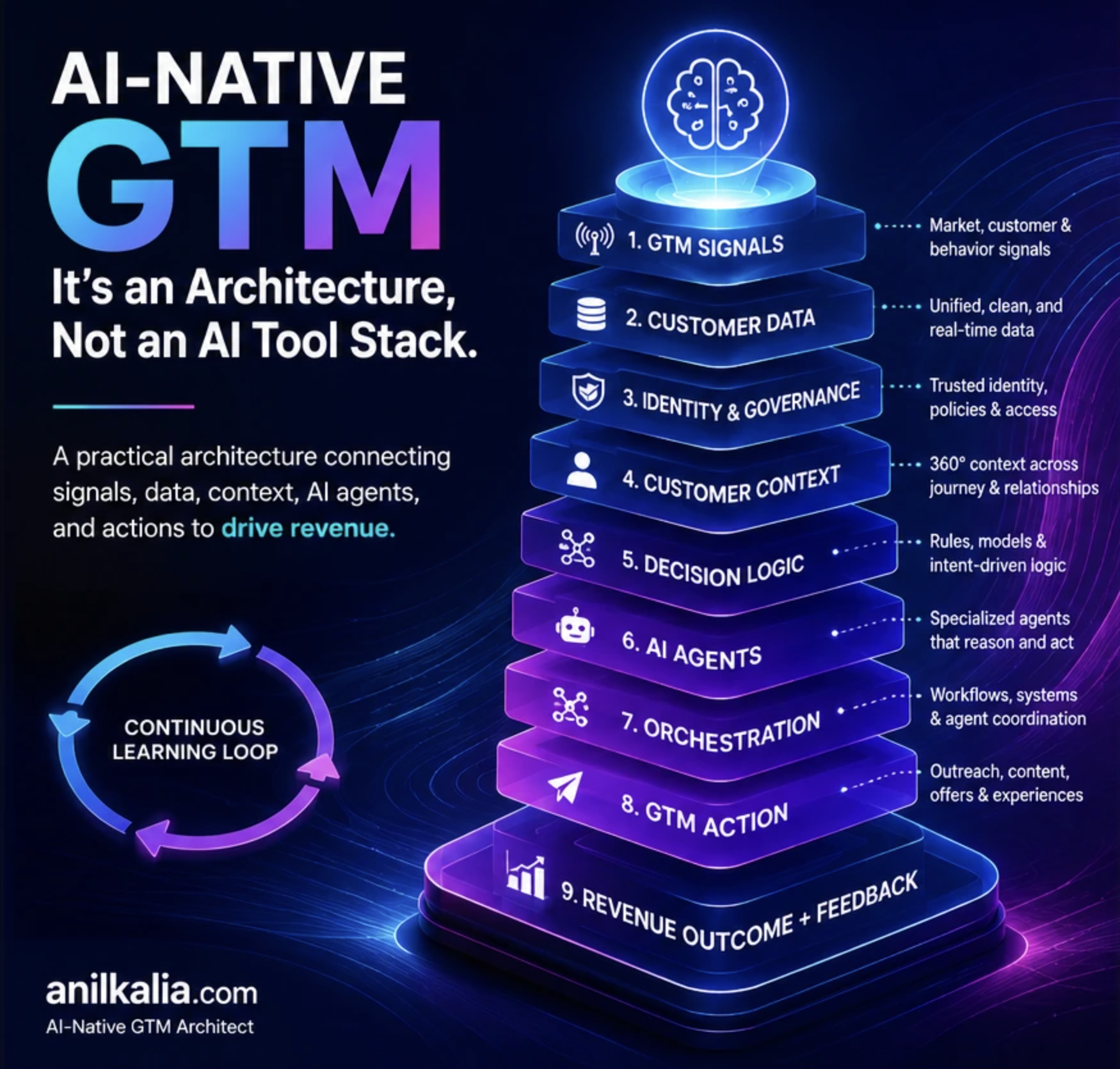
The 9 Layers of AI-Native GTM
1. GTM Signals — What changed?
Every useful GTM action begins with a signal: a demo request, product activity, pricing-page visit, new stakeholder engagement, contract milestone, support escalation, funding event, job change, churn indicator, or another meaningful change.
Signals should describe something that happened. They should not automatically prescribe the action.
2. Customer Data — What do we know?
The signal needs to connect to reliable customer data from CRM, marketing, product, support, finance, billing, contracts, and relevant external sources.
This is where many AI initiatives inherit years of GTM debt. Duplicate accounts, inconsistent lifecycle stages, missing ownership, disconnected product usage, and stale opportunities become part of the AI agent's reality.
3. Identity & Governance — Who is this, and what are we allowed to do?
Before AI can reason over customer data, the system has to resolve identity and establish governance. Which company does this contact belong to? Is it a parent account or subsidiary? Is the record a prospect, customer, partner, or former customer? Which system owns each critical field?
Governance also determines access, consent, permissions, data quality, auditability, and the boundaries within which an agent can act.
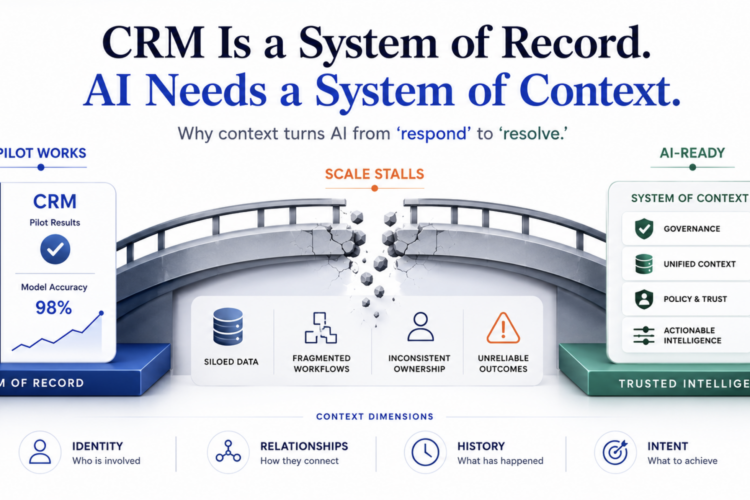
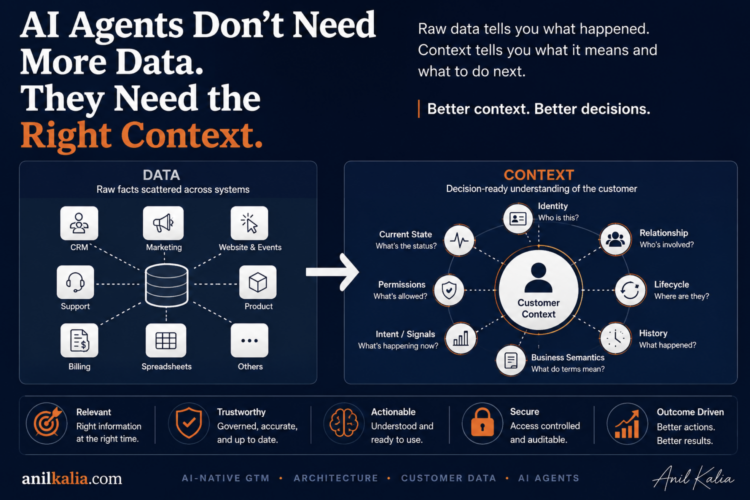
4. Customer Context — What does the signal mean here?
Raw data from CRM, product, marketing, support and other systems.
Resolve who the person, account and relationship actually are.
Assemble the trusted information required for this decision now.
Determine the allowed next-best action.
Context is more than a 360-degree customer view. It is the subset of trusted information required to make a particular GTM decision.
A pricing-page visit means something very different for a new prospect, an active enterprise opportunity, an existing customer approaching renewal, and a churn-risk account.
The raw event is identical. The context changes the decision.
5. Decision Logic — What should happen?
Decision logic converts context into an allowed next step. Some decisions should remain deterministic: suppression rules, territory ownership, contractual restrictions, approval thresholds, compliance rules, or basic qualification requirements.
Other decisions can benefit from probabilistic models or AI reasoning: prioritization, message selection, research synthesis, risk assessment, or recommended next-best action.
AI-native architecture does not eliminate rules. It combines rules and intelligence deliberately.
6. AI Agents — Who reasons and executes?
An AI agent is one actor inside the architecture, not the architecture itself.
Different agents may specialize in account research, qualification, opportunity inspection, renewal preparation, deal support, customer expansion, or operational administration. Their usefulness depends on the context and tools they are given, the boundaries around those tools, and how their output is evaluated.
7. Orchestration — How do systems work together?
Agents rarely operate in isolation. They need workflows, APIs, webhooks, queues, CRM automations, integration platforms, approval steps, and event triggers that coordinate activity across systems.
This is the layer that turns a clever agent demo into a repeatable operating process.
8. GTM Action — What changes in the real system?
The action might be an outreach draft, a routed lead, a sales task, a renewal alert, a CRM update, a campaign change, an escalation, a research brief, or another system action.
The closer an action gets to customers, pricing, contracts, or material revenue decisions, the more carefully its permissions should be designed.
9. Revenue Outcome + Feedback — Did it work?
An AI-native system needs to capture what happened next. Did the prospect reply? Was the account routed correctly? Did the opportunity advance? Did the renewal close? Was the recommendation ignored or overridden by a human?
Without feedback, AI automation is simply execution. With feedback, it can become a learning system.
learning and
improvement
AI-Enabled GTM vs AI-Native GTM
AI-Enabled
AI improves individual tasks inside an existing GTM model.
- Copilots
- AI writing
- Call summaries
- Standalone scoring
- Point automations
AI-Native
AI participates in a connected decision architecture.
- Shared customer context
- Signal-driven workflows
- Governed agent actions
- Cross-system orchestration
- Outcome feedback
Both approaches can create value. The mistake is assuming that buying enough AI-enabled tools eventually produces an AI-native operating model. It does not.
A Practical B2B Scenario
Consider a prospect from a target account who downloads a pricing guide.
In a traditional automation model, the event might trigger a lead score increase, place the contact into a nurture sequence, or create a sales alert.
In an AI-native architecture, the system first resolves the account and reconstructs the relevant context. It checks whether the company is already a customer, whether an opportunity exists, which rep owns the account, whether other stakeholders are active, how the account fits the ICP, what product activity exists, and which commercial rules apply.
The decision layer then determines whether the right response is sales outreach, nurture, suppression, expansion, escalation, or no action.
If an agent is permitted to participate, it can prepare the research, recommend the next step, draft an appropriate message, or perform a bounded operational action. A human can remain in the approval loop where the decision is commercially sensitive.
The important difference is that the agent is not acting on the download alone. It is acting on the meaning of the download inside the customer relationship.
What Belongs in an AI-Native GTM Stack?
The exact vendors matter less than the capabilities. A useful architecture usually includes five broad layers:
Data Foundation
CRM, warehouse/lakehouse, ETL/ELT, APIs, customer identity, data quality, MDM.
Intelligence
Models, scoring, predictions, retrieval, recommendations, intent and decision support.
Agent Layer
Specialized agents for research, sales, marketing, CS, RevOps, and other bounded use cases.
Orchestration
Workflows, rules, triggers, webhooks, integrations, approvals, retries and observability.
Experience
CRM, email, chat, portals, dashboards, alerts and the interfaces through which humans supervise the system.
A strong AI-native GTM stack may still contain HubSpot, Salesforce, a data warehouse, an integration platform, BI tools, and familiar MarTech. The architectural change is how those systems share context and coordinate decisions.
A Practical Maturity Model
Level 1 — Assisted: AI helps individuals become more productive.
Level 2 — Automated: AI and rules automate repeatable tasks inside existing workflows.
Level 3 — Contextual: AI can access unified, governed customer context when making recommendations.
Level 4 — Agentic: agents can act across systems within explicit permissions and escalation paths.
Level 5 — AI-Native: the GTM system connects signals, context, decisions, actions, outcomes, and feedback as one learning architecture.
Level 5 should not mean humans disappear. It means human judgment is used where it creates the most value rather than where the system happens to be missing context.
What Should Remain Human-Controlled?
Automate
Repetitive, rule-based, high-volume tasks with clear boundaries and low downside.
Agent + Approval
AI researches, recommends or prepares the action; a human reviews before execution.
Human Decision
High-impact, strategic, ethical, contractual, relationship-heavy or irreversible decisions.
Not every GTM activity should be delegated to an agent.
Repetitive, rule-based, high-volume tasks are obvious candidates for automation. AI can prepare or recommend more complex work while humans review and approve it. High-impact strategic, ethical, contractual, or relationship-heavy decisions should remain human-led.
The important architectural question is not Can AI do this?
How to Start Without Rebuilding Everything
You do not need to replace the entire GTM stack to move toward AI-native architecture.
2. Define the context required for one high-value decision.
3. Make the decision logic explicit.
4. Add an agent only where it improves the workflow.
5. Orchestrate the action across existing systems.
6. Capture the outcome and feed it back.
A good first project is intentionally narrow: one signal, one decision, one agent or automation, one bounded action, and one measurable outcome.
For example, redesigning inbound lead routing around customer context is a better starting point than launching five autonomous agents across the entire revenue lifecycle.
AI-Native GTM Architecture Checklist
- Do we have a trusted customer/account identity?
- Can important GTM signals be consumed in a usable timeframe?
- Do we know which data is authoritative for each decision?
- Can the system assemble customer context across the lifecycle?
- Are routing, prioritization, suppression, and approval rules explicit?
- Do agents have clearly defined tools and permissions?
- Do sensitive actions have human review where appropriate?
- Can we observe what the agent saw, decided, and changed?
- Do we measure revenue outcomes rather than activity alone?
- Does feedback improve the next decision?
Key Takeaway
AI-native GTM is not a future label for companies that buy enough AI products.
It is an architecture for making better revenue decisions with machines and humans working inside the same operating system.
Companies that get this architecture right will be able to add new agents without rebuilding the foundations every time.
Companies that skip the architecture may simply automate fragmented processes faster.
Where Is Your GTM Architecture Breaking?
If you are experimenting with AI agents, customer context, routing, orchestration, or AI governance, I am interested in the architecture problems you are seeing in practice.
Share the problem or a different approach. The useful conversation is usually in the edge cases.
Continue the architecture discussion →Discussion-oriented CTA. No services offer.