

The attribution model debate in most organisations is treated as a technical question — which model does HubSpot support, and which one should the marketing analyst configure? It is not a technical question. It is a strategic one. The model you choose is a statement about how your organisation believes revenue is created — and choosing the wrong one means measuring the wrong things, optimising the wrong channels, and making the wrong investment decisions with real commercial consequences.
- Why attribution model choice is a strategic decision
- The six models — what each measures and what each misses
- The attribution conflict: why Marketing and Sales always disagree
- Matching model to GTM motion: the decision framework
- The case for running multiple models simultaneously
- Data requirements: what HubSpot needs to attribute accurately
- The attribution gaps no model solves
- Building an attribution practice, not just a report
Why attribution model choice is a strategic decision
Every attribution model is built on an assumption about how buyers make decisions. First-touch assumes the moment of awareness is causally responsible for the eventual purchase. Last-touch assumes the final interaction before conversion is what drove it. Multi-touch models assume that multiple interactions across the buyer journey each contribute meaningfully to the outcome.
None of these assumptions is universally true. All of them are true for some buyers in some markets with some sales motions. The strategic question is not which model is most accurate in theory — it is which model most closely reflects how your specific buyers actually make decisions about your specific product. Get that question right and attribution becomes a genuinely useful decision-making tool. Get it wrong and attribution becomes a politically contested reporting exercise that consumes analyst time while producing data nobody fully trusts.
The stakes are real. A company running last-touch attribution that attributes 70% of revenue to the demo request form will systematically underinvest in the awareness channels — content, SEO, events, brand — that were responsible for bringing buyers to the demo request in the first place. The form conversion is visible and measurable. The eighteen months of brand-building that made the prospect receptive to the form is invisible under last-touch. Over three years, that systematic underinvestment compounds into a meaningfully weaker top-of-funnel than the data suggested was warranted.
The most common attribution-driven strategic error: cutting brand and content investment because last-touch attribution shows those channels produce minimal revenue — while simultaneously wondering why pipeline quality and volume are declining six to twelve months later. The channels that build pipeline visibility tend to operate on longer time horizons than the attribution models used to measure them. Last-touch attribution is particularly dangerous for channels with long influence windows.
The six models — what each measures and what each misses
The attribution conflict: why Marketing and Sales always disagree
The attribution dispute between Marketing and Sales is not fundamentally about data. It is about incentive structures. Marketing is typically measured on MQL volume and marketing-sourced pipeline — metrics that benefit from attribution models that credit marketing touchpoints. Sales is typically measured on revenue closed — a metric that makes attribution of marketing's contribution feel like a claim on their success.
When Marketing runs first-touch attribution and reports that 65% of revenue was marketing-sourced, Sales disputes the number. When Sales runs last-touch attribution and reports that only 12% of revenue can be attributed to marketing, Marketing disputes that number. Both are correct by their chosen model. Neither is telling the complete truth about how revenue was actually created.
Both stories are partially true. The attribution model that resolves this dispute does not exist — because attribution is inherently a simplification of a complex causal chain. The practical resolution is not finding the "correct" model. It is agreeing on which model each team uses for which decisions, and ensuring that both teams review the same dashboard in the same meeting so that discrepancies are discussed rather than exploited.
The attribution conflict becomes most damaging when each team uses its preferred model to justify budget requests or defend performance numbers to leadership — without the other team present. The CFO or CEO hearing two irreconcilable attribution stories from the same revenue team loses confidence in both. The solution is a single shared attribution model for leadership reporting, with supplementary models used internally by each team for optimisation decisions. One number to the board. Multiple models for internal learning.
Matching model to GTM motion: the decision framework
| GTM motion | Recommended model | Rationale | What to watch for |
|---|---|---|---|
| Inbound-led SaaS (short cycle, SMB) | Last touch | Short cycles mean recent engagement is genuinely most predictive. The buyer's journey is compressed — the touchpoint closest to conversion is the most causally relevant. | Will undervalue brand and content if those channels produce awareness but not direct conversion. Supplement with first-touch view for channel investment decisions. |
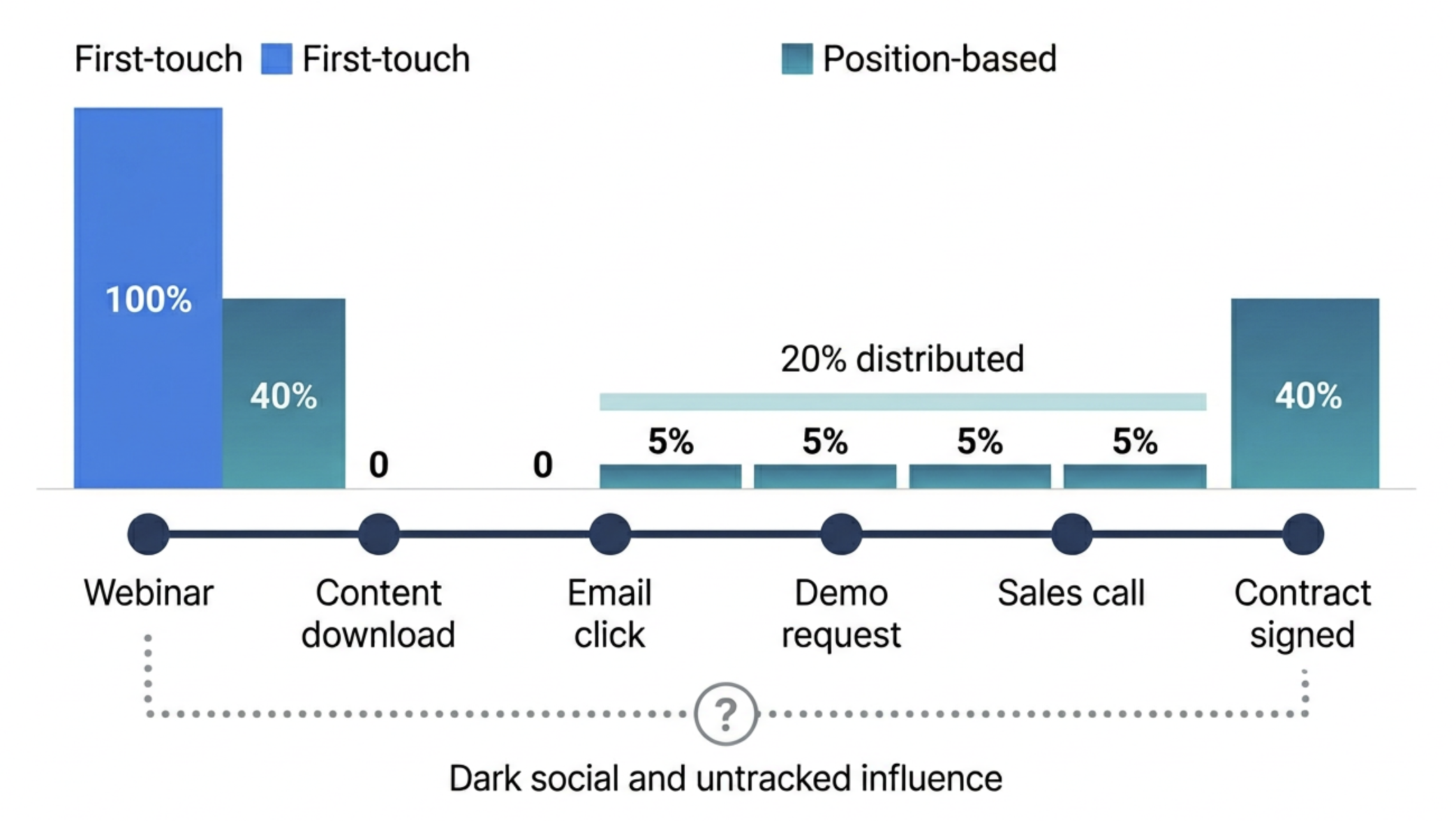
| Inbound + outbound, mid-market B2B | Position-based | Longer cycles with both marketing and sales contributions. Position-based balances awareness credit (first touch) with conversion credit (last touch) while acknowledging nurture in between. | The 40/20/40 split is an assumption, not a measurement. Validate it against your actual pipeline data after 6 months and adjust if the data suggests a different distribution. |
| Enterprise, account-based | Data-driven | Complex buying committees and long cycles mean no simple model reflects reality. Data-driven attribution removes human assumptions and replaces them with statistical evidence from your actual pipeline. | Requires 200+ closed deals with complete interaction histories before the model is reliable. Before that threshold, position-based is more trustworthy than data-driven despite being less sophisticated. |
| Product-led growth | Position-based or linear | PLG touchpoints are distributed across product engagement, content, and community — no single touchpoint dominates. Linear or position-based models reflect the distributed influence pattern without over-crediting any single channel. | Product engagement touchpoints must be synced into HubSpot from the product to be included in attribution. Without product data in the CRM, the attribution model is incomplete by definition. |
| Outbound-led, enterprise | First touch + source-based | In purely outbound motions, the first sales touchpoint (cold outreach, event meeting, referral) is the awareness event. First-touch combined with a source property that captures outreach channel gives the most useful channel performance data. | Digital marketing attribution models are largely irrelevant for purely outbound motions — the buyer journey begins in the sales process, not in a content consumption funnel. |
| High-volume ecommerce (DTC) | Last touch for paid + first touch for organic | Paid channels (Google, Meta) are best evaluated on last-touch because they are optimised for direct response. Organic channels (SEO, content) are best evaluated on first-touch because their value is in bringing buyers into the funnel, not closing them. | Running different models per channel type creates reporting complexity. Document the model used per channel clearly to prevent misinterpretation when numbers are shared with leadership. |
The case for running multiple models simultaneously
The strongest attribution practice for most B2B organisations is not choosing one model — it is running two or three models simultaneously, each answering a different question, and being explicit about which question each model is answering when results are shared.
The practical dual-model approach for most mid-market B2B companies:
- Position-based as the primary model: used in leadership reporting, in budget allocation discussions, and in the monthly RevOps review. This is the single number that Marketing and Sales agree to use when talking to the CFO and CEO. It is not perfect — no model is — but it is defensible, balanced, and consistently applied.
- First-touch as the supplementary model: used internally by Marketing to evaluate which awareness channels are building the top-of-funnel pipeline that the primary model will eventually credit. A channel that shows strong first-touch attribution but weak position-based attribution is producing awareness without conversion — a different problem from a channel that shows nothing in either model.
- Source-based attribution as the diagnostic model: built on the Source Type or Original Source properties rather than on HubSpot's touchpoint-based attribution models. Answers: what category of activity brought this buyer into our world? Used quarterly to assess whether the channel mix is healthy.
The model that nobody talks about but every RevOps team needs: the gap model. The gap between what first-touch attributes to a channel and what position-based attributes to the same channel shows how much mid-funnel influence that channel has. A channel with strong first-touch but weak position-based attribution is creating awareness but not sustained engagement. A channel with weak first-touch but strong position-based attribution is closing buyers who arrived through other channels. Both insights are useful. Neither is visible from a single model.
Data requirements: what HubSpot needs to attribute accurately
Attribution is only as good as the tracking infrastructure behind it. The most sophisticated model applied to incomplete data produces confidently wrong conclusions. Before deciding which model to implement, audit whether HubSpot has the data required to run it reliably.
| Data requirement | Common gap | Fix |
|---|---|---|
| UTM parameters on all campaign links | Inconsistent UTM usage across campaigns means some touchpoints are not tracked to source, inflating "direct" attribution | UTM governance document and naming convention. Audit all active campaigns quarterly for UTM compliance. |
| HubSpot tracking code on all pages | Landing pages hosted outside HubSpot — on WordPress, Webflow, or a custom CMS — that are missing the tracking code create anonymous sessions that cannot be attributed | Tracking code audit across all domains and subdomains. Include in new page launch checklist. |
| Offline touchpoints logged | Events, trade shows, phone calls, and in-person meetings are not tracked automatically. If not logged manually, they do not appear in attribution reports | Activity logging discipline in sales team. Event attendance synced from event platforms via Operations Hub. Call logging via HubSpot calling or connected telephony tool. |
| Contact creation source accuracy | Contacts created by CSV import or admin often have incorrect or missing Original Source data — attributing them to "offline sources" by default | Set Original Source explicitly on bulk imports via workflow. Require source confirmation for admin-created contacts before record completion. |
| Product engagement data | For SaaS and PLG companies, product touchpoints — trial activation, feature usage milestones — are invisible to HubSpot attribution unless synced from the product database | Operations Hub webhook integration from product to HubSpot. Log product engagement as custom activities against the Contact record. |
The attribution gaps no model solves
Every attribution model in HubSpot — including data-driven — has structural blind spots that cannot be closed by better configuration. Being honest about these gaps prevents over-reliance on attribution data for decisions it cannot support.
- Dark social and word of mouth: a buyer who heard about your product from a colleague on Slack, saw your CEO speak at a conference, or encountered your brand through a private community will arrive at your website with no visible referral source. HubSpot will attribute them to "direct." The influence that created their intent is structurally invisible to any cookie-based attribution model.
- Multi-device journeys: a buyer who researches your product on their phone during a commute and then converts on their work laptop later in the day appears as two separate anonymous sessions followed by a single contact. The mobile research session — potentially the moment genuine interest was formed — is lost.
- Pre-form awareness: everything that happened before a buyer submitted their first HubSpot form is invisible to HubSpot's attribution model unless they were already a known contact. For most B2B companies, the majority of the awareness journey happens before form submission — in Google searches, competitor comparison reviews, peer conversations, and LinkedIn content consumption.
- Relationship and reputation: a buyer who chose your company because of your brand's reputation for reliability, your CEO's thought leadership, or a trusted advisor's recommendation may have clicked on a demo request ad as their final visible touchpoint — giving that ad full last-touch credit for a decision that was made months earlier through channels that left no digital trace.
The honest statement every CMO should be able to make to their CFO: "Our attribution model measures the touchpoints we can track. It is our best available proxy for understanding how marketing contributes to revenue — but it systematically underestimates the contribution of channels that operate primarily through influence, reputation, and relationships. The model improves our decisions. It does not make them for us."
Building an attribution practice, not just a report
An attribution report is a document. An attribution practice is a repeating organisational process that uses attribution data to make better decisions over time. Most companies have the former. The ones that compound their marketing investment advantage have the latter.
An attribution practice has four components that a report does not:
- A documented model selection rationale. The choice of which model to use, why it was chosen, and what question it is intended to answer — written down and shared with every stakeholder who will use the data. Without this document, the same attribution number will be interpreted differently by different people, leading to the disputes that make attribution politically toxic.
- A defined review cadence. Attribution data reviewed monthly alongside pipeline data, not quarterly in isolation. The monthly review asks: are the channels showing strong attribution actually filling pipeline? Are the channels showing weak attribution genuinely underperforming, or are they producing influence that the model cannot measure?
- A channel investment feedback loop. Attribution data informs budget allocation decisions with a defined lag — typically one quarter — that reflects the time it takes for channel investment changes to show up in pipeline. Making attribution-driven budget cuts in the same month the data is reviewed is too fast for channels with long influence windows.
- A model review schedule. The attribution model is reviewed annually against the company's current GTM motion. A company that started with position-based attribution at $10M ARR and is now at $80M ARR with a larger sales team and a more complex buying committee may need to evolve to data-driven attribution. The model should grow with the business.
→For the foundational HubSpot attribution model configuration and reporting setup, see Article: Revenue attribution models in HubSpot — first-touch, multi-touch & beyond.