
HubSpot RevOps

How to evaluate a HubSpot RevOps consultant: 10 questions to ask

The HubSpot partner ecosystem contains thousands of certified agencies and consultants. Certification is not a quality signal — it is a minimum entry requirement. The questions that distinguish a consultant who will build something your organisation relies on for the next five years from one who will deliver a technically competent but commercially inert implementation are not on any certification exam. They are the questions in this blog.

In this article
  1. Why HubSpot certification is not a selection criterion
  2. The 10 questions — with what good and bad answers look like
  3. The red flags that should end a conversation
  4. The green flags that signal a genuine RevOps architect
  5. How to structure the evaluation process
  6. What a good engagement proposal looks like
  7. The question you should ask yourself before hiring anyone

Why HubSpot certification is not a selection criterion

HubSpot's partner certification programme is genuinely useful — it ensures that partners understand the platform's features, best practices, and implementation methodology. It is not, however, a proxy for the quality of work a partner will produce for your specific organisation with your specific go-to-market model and your specific RevOps maturity level.

A five-diamond HubSpot partner has generated significant revenue through HubSpot implementations. That is what the tier measures — commercial volume, not implementation quality. A two-diamond partner with deep expertise in your industry and a documented methodology for RevOps architecture may be a materially better choice than a five-diamond partner whose team has rotated through ten generalist certifications but has never built a lifecycle architecture for a SaaS company at your growth stage.

The evaluation framework that follows is designed to surface the distinction between a HubSpot implementer — someone who can configure the tool to its documented specifications — and a HubSpot RevOps architect — someone who understands your business model, designs a system that serves it, and can explain why every decision was made.

The most expensive consulting mistake in HubSpot RevOps: selecting a partner based on their tier and their price and discovering six months into the engagement that their methodology consists of following HubSpot's default onboarding guide. Default onboarding produces a functional CRM. It does not produce a revenue architecture. The difference between the two is the scope and quality of the diagnostic work done before any configuration begins — which is precisely what these ten questions are designed to surface.

The 10 questions — with what good and bad answers look like

1
Before you recommend any HubSpot configuration, what does your discovery process look like?
Why this matters: the quality of a HubSpot implementation is determined by the quality of the diagnostic work done before configuration begins. A consultant who moves to configuration quickly is either very confident or not asking the right questions.
This question reveals whether the consultant operates from a methodology or from a template. A good discovery process takes two to four weeks, involves multiple stakeholders, and produces a written output — a data model spec, a RevOps alignment document, or an architecture brief — before a single property is created in HubSpot.
Good answer
"We run a structured discovery that covers your current GTM motion, your data model, your tech stack integrations, your lifecycle definitions, and your reporting requirements. We produce a written architecture brief that you sign off before any configuration begins. Discovery typically takes three to four weeks."
Concerning answer
"We start with a kick-off call and then get into HubSpot pretty quickly — we find it's more efficient to configure and iterate than to over-plan upfront."
2
Can you describe a HubSpot implementation that did not go well, and what you learned from it?
Why this matters: every experienced consultant has a failed or struggling engagement in their history. How they describe it reveals their self-awareness, their problem-solving approach, and whether they take accountability for outcomes.
The answer to this question is more revealing than any case study. A consultant who claims every engagement has gone smoothly is either inexperienced or not being honest. A consultant who can describe a specific failure, explain its root cause, and articulate what they changed as a result is demonstrating the kind of reflective practice that produces reliable work.
Good answer
"We had an implementation where we underestimated the data quality issues in the client's legacy CRM and committed to a timeline that was too aggressive. The migration was delayed by six weeks and the client's confidence was affected. We now require a data quality audit as a prerequisite before committing to any migration timeline."
Concerning answer
"We've been fortunate — our clients tend to be well-prepared and our implementations run smoothly." Or: a story that places all blame on the client with no reflection on what the consultant could have done differently.
3
How do you approach lifecycle stage design, and what does your process for getting Marketing and Sales to agree on definitions look like?
Why this matters: lifecycle stage misalignment is the most common cause of HubSpot implementation failure. A consultant who has a process for facilitating this alignment is one who has encountered the problem before and solved it.
This question tests whether the consultant understands that lifecycle design is an organisational problem, not a technical one. The technical configuration of lifecycle stages takes an hour. Getting Marketing and Sales to agree on what each stage means takes a structured facilitation process — and a consultant who skips it is setting the implementation up for the most predictable failure mode in the ecosystem.
Good answer
"We run a lifecycle definition workshop with Marketing and Sales leadership together — never separately. We use a structured template that requires the group to define entry criteria, exit criteria, and the specific question 'what does a contact in this stage need in order to advance?' in writing. The output is a definitions document that both VPs sign off before any workflow is built."
Concerning answer
"We configure HubSpot's standard lifecycle stages and adjust them based on feedback after go-live." Or: no mention of organisational alignment — only technical configuration.
4
What is your approach to data governance, and what do you deliver at the end of an engagement to ensure the system stays healthy after you leave?
Why this matters: an implementation without a governance handoff creates dependency on the consultant. A good consultant leaves the organisation capable of maintaining the system independently.
This question distinguishes consultants who build implementations from those who build capabilities. The answer reveals whether the consultant views post-engagement system health as their responsibility or the client's problem. Governance deliverables — data dictionary, workflow registry, property naming convention, access matrix — should be standard outputs of any RevOps engagement, not optional add-ons.
Good answer
"We deliver a governance pack at the end of every engagement: a data dictionary, a workflow registry, a property naming convention guide, an access matrix, and a quarterly audit checklist. We also run a knowledge transfer session with your RevOps team — not just a handover call — before the engagement closes."
Concerning answer
"We document everything inside HubSpot." HubSpot workflow descriptions and property notes are not a governance framework. They are internal labels that disappear when the workflow is modified.
5
Have you worked with companies at our stage and in our industry? What was different about how you approached their implementation?
Why this matters: a SaaS company at $15M ARR with a PLG motion needs a different HubSpot architecture than a financial services firm at $80M revenue with a relationship-led sales motion. Generic experience is not industry experience.
The answer reveals whether the consultant understands that industry context shapes implementation decisions — not just which features to use but which design choices are appropriate for the commercial model, compliance environment, and buyer behaviour of your specific market.
Good answer
A specific example with concrete detail: "We worked with a Series B SaaS company at a similar ARR. The key difference from a standard implementation was building the trial-to-paid lifecycle in HubSpot using product event webhooks through Operations Hub, rather than the standard lead-to-opportunity model. That required designing the data model around subscription objects before any lifecycle logic was built."
Concerning answer
"We work with companies across all industries — HubSpot is flexible enough that the approach is broadly similar." This answer reveals either inexperience with your sector or a one-size-fits-all methodology that will not serve your specific needs.
6
How do you handle scope changes during an engagement, and can you give an example of a project where the scope changed significantly?
Why this matters: scope change is inevitable in complex implementations. How a consultant handles it reveals their commercial integrity and their project management maturity.
HubSpot RevOps implementations frequently surface complexity that was not visible at discovery. A consultant with a mature scope change process acknowledges this reality rather than pretending their initial estimate was comprehensive. The question reveals whether they have a transparent mechanism for managing scope — or whether scope changes become implicit and lead to relationship friction.
Good answer
"We have a formal change request process. If something falls outside the original scope, we document it, estimate the additional effort, and bring it to you for a decision before doing the work. We had one engagement where the client's integration requirements were significantly more complex than the discovery revealed — we presented a written scope change, the client approved it, and we adjusted the timeline and budget transparently."
Concerning answer
"We try to accommodate reasonable requests within the original scope." This is the answer that leads to resentment on both sides when "reasonable" is interpreted differently by each party.
7
What does your reporting deliverable look like at the end of an engagement, and how do you ensure the dashboards you build actually get used?
Why this matters: dashboards built by consultants are frequently abandoned within 90 days of delivery because they were designed for what the consultant thought leadership needed rather than what leadership actually reviews.
This question reveals whether the consultant involves leadership in defining reporting requirements or presents reporting as a feature delivery. Reports that leadership uses are reports that leadership helped specify — in conversations where they were asked "what decision would this data help you make?" rather than shown what is technically possible.
Good answer
"We run a reporting requirements session with each stakeholder audience — RevOps, sales leadership, marketing, executive — and document the specific decisions each audience makes that HubSpot data should inform. We build to that specification, not to what is technically possible. We also present the dashboards in the context of a real pipeline review meeting before the engagement closes, to verify that the data is answering the right questions."
Concerning answer
"We deliver a full suite of dashboards covering pipeline, attribution, and lifecycle performance. We can show you examples from previous clients." Examples from previous clients are not a specification for your organisation's reporting needs.
8
How do you measure success at the end of an engagement, and what metrics do you use to evaluate whether the implementation is working six months after go-live?
Why this matters: a consultant who measures success by delivery completion is measuring their performance, not yours. A consultant who measures success by commercial outcomes is accountable to the same things you are.
The answer reveals the consultant's accountability orientation. Delivery-focused consultants measure success by milestones met and features deployed. Outcome-focused consultants measure success by adoption rates, data quality improvements, pipeline report accuracy, and — ultimately — whether the revenue team is making better decisions because of the implementation.
Good answer
"We define success metrics at the start of the engagement alongside the client — typically including adoption rate by role, data completeness rate on key properties, pipeline report accuracy, and time-to-first-meaningful-report for a new user. We propose a 90-day post-go-live check-in as part of every engagement to assess these metrics and address any emerging issues."
Concerning answer
"Success is delivering the agreed scope on time and on budget." This is a project management definition of success, not a RevOps one.
9
Who will actually be doing the work on our engagement, and how does your team handle knowledge transfer if that person leaves during the project?
Why this matters: the person who sells the engagement is rarely the person who delivers it. Understanding who specifically will be in your HubSpot portal — and what happens if they leave — is a risk management question, not a relationship one.
This question surfaces the bait-and-switch dynamic that is endemic in consulting. The senior partner presents and wins the business. A junior analyst delivers it. At some firms this is openly acknowledged and the junior analyst is competent and well-supervised. At others it is obscured and the quality difference is significant. Ask to meet the delivery team, not just the sales team.
Good answer
"Your engagement will be led by [named person] who has [specific experience]. I'll be involved in the architecture decisions and the key milestones. We document all engagement work in a shared project space — if anyone transitions off the team, the incoming person has full context from day one. Would you like to meet the delivery lead before we proceed?"
Concerning answer
"Our whole team is excellent — we'll assign the best people for your project." An answer that avoids naming individuals is an answer that is avoiding accountability for who will actually do the work.
10
What should we NOT hire you for?
Why this matters: a consultant who can articulate their limitations is one who knows their strengths. A consultant who claims to do everything well does everything adequately and nothing exceptionally.
This is the most revealing question on the list. Every specialised consultant has genuine areas of expertise and genuine areas of limitation. A RevOps architect who is outstanding at data model design and lifecycle architecture may be less strong at change management and adoption programming — and should say so. The answer tells you whether you are speaking with a specialist or a generalist wearing a specialist's label.
Good answer
"We're strongest on the architecture and data model side — that's where we invest most of our methodology development. If change management and executive stakeholder alignment are your primary challenges, you may benefit from pairing us with an organisational change consultant. We've done that successfully with a few clients." Or: a specific industry or use case they do not cover well.
Concerning answer
"Honestly, we cover the full spectrum — strategy, implementation, change management, and ongoing optimisation. We're a one-stop shop." A one-stop shop that excels at everything is a sales pitch, not a capability assessment.

The red flags that should end a conversation

Proposes to start configuration before discovery is complete
Building without understanding produces a technically correct implementation of the wrong thing. Any urgency to start configuring before the diagnostic work is finished is a red flag regardless of the justification.
Cannot explain their methodology without using HubSpot's marketing language
If a consultant describes their process using phrases from HubSpot's own documentation — flywheel, inbound methodology, power of the platform — without translating it to your specific context, they may not have a methodology of their own.
Proposal contains no discovery or data audit phase
A proposal that moves directly from kick-off to configuration is a proposal built on assumptions. Those assumptions will cost more to correct than the discovery would have cost to conduct.
References are all from HubSpot's case study library
Published case studies are marketing assets, not independent references. Ask for direct introductions to three clients at a similar company stage and industry. The willingness to provide them — and the quality of those conversations — is the most reliable quality signal available.

The green flags that signal a genuine RevOps architect

Asks about your RevOps maturity before recommending scope
A consultant who asks how many people are in RevOps, what their technical background is, and what has been tried before — before making any recommendations — is one who understands that the right solution is context-dependent.
Disagrees with you about something in the first meeting
A consultant who agrees with everything you say in a pitch meeting will agree with everything you say during the engagement — and implement your assumptions rather than challenging them. Productive disagreement in the evaluation phase is a signal of intellectual honesty.
Asks what success looks like in 12 months, not 3
A consultant oriented toward long-term commercial outcomes rather than short-term delivery milestones is one whose incentives are aligned with yours. Delivery-focused consultants optimise for go-live. Outcome-focused consultants optimise for adoption and commercial impact.
Their proposal includes something you did not ask for
A consultant who identifies a risk or a gap you did not mention — and includes a recommendation for it in the proposal without being asked — is demonstrating that their diagnostic process is genuinely analytical rather than simply responsive to the brief.

How to structure the evaluation process

A rigorous consultant evaluation for a significant HubSpot RevOps engagement should involve four stages, each designed to surface a different dimension of the candidate's capability.

  1. Initial screening call (30 minutes): ask questions 1, 2, and 10 from the list above. The answers to these three questions will eliminate a significant portion of candidates without requiring a full pitch. You are looking for methodological clarity, self-awareness, and the confidence to name limitations.
  2. Methodology presentation (60 minutes): ask the shortlisted consultants to walk through their implementation methodology for a company at your stage. Do not give them a brief in advance — the quality of their preparation and the appropriateness of their default methodology for your context is part of what you are evaluating.
  3. Working session (90 minutes): present a specific challenge — a data model decision, a lifecycle design problem, or an attribution configuration question — and work through it with the consultant in real time. This reveals how they think, not how they present.
  4. Reference conversations: direct conversations with two or three clients at a comparable stage. Ask those clients specifically: what did the consultant get wrong, and how did they handle it? The answer to the second part of that question matters more than the answer to the first.

What a good engagement proposal looks like

A proposal from a genuine RevOps architect contains six elements that distinguish it from a standard agency proposal:

  • A diagnostic summary: a brief written assessment of what they observed about your current state — from the discovery conversation — and the specific risks and opportunities they identified. This section does not exist in template proposals because it requires actual diagnostic work to produce.
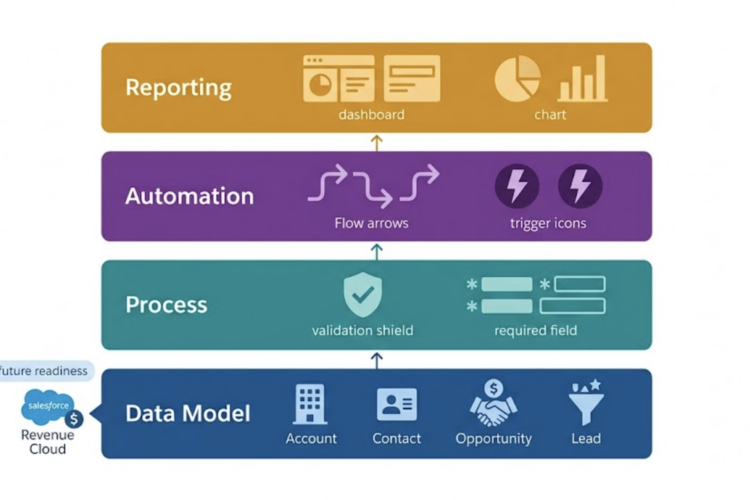
  • A phased architecture plan: data model first, lifecycle logic second, automation third, reporting last — with explicit sequencing rationale. A proposal that presents all phases simultaneously without sequencing is one that does not prioritise correctly.
  • Clearly defined deliverables per phase: not "HubSpot configured" — but "data dictionary documented, property naming convention implemented, sample import of 100 records validated, lifecycle stage definitions signed off by Marketing and Sales leadership."
  • Governance deliverables specified: the documentation, training, and handover materials that will be delivered at engagement close. If these are not in the proposal, they will not be delivered.
  • Named delivery team with roles: who specifically will be doing the work, at what seniority, and what their accountability is for each phase.
  • Success metrics defined: how the engagement will be evaluated at 30, 60, and 90 days post-go-live, and who is responsible for measuring them.

The question you should ask yourself before hiring anyone

After every evaluation process, before making a final decision, ask yourself one question: does this consultant understand my business well enough that I would trust them to make configuration decisions independently when I am not in the room?

If the answer is yes — they have demonstrated understanding of your GTM motion, your data requirements, your team structure, and your commercial objectives — then the technical questions become secondary. A consultant who truly understands your business will make defensible configuration decisions even in ambiguous situations.

If the answer is no — the conversations have been technically impressive but commercially thin — then no amount of certification, case studies, or proposal quality will compensate for the fact that the consultant does not yet understand what they are building and why.

The best HubSpot RevOps consultants are not the ones who know HubSpot most deeply. They are the ones who understand revenue operations most clearly and use HubSpot as the infrastructure to implement it. The platform knowledge can be learned. The revenue operations thinking has to already be there. Every question in this list is designed to surface that thinking — or its absence.
This article is the final entry in the 24-article HubSpot RevOps Series. The full series index, organised by layer and industry, is available at the top of the article.
About this series
The HubSpot RevOps Series covers the full spectrum of Revenue Operations practice — from foundational architecture (Articles 01–08), through industry-specific implementation (Articles 09–18), to comparison and decision frameworks for buyers evaluating their options (Articles 19–24). Each blog is written for practitioners who need depth, not marketers who need coverage. If a blog in this series has been useful to your work, the highest compliment is sharing it with someone who needs it.