The question is not whether HubSpot scales to enterprise — it does. The question is what the architecture looks like at each scale, where the configuration priorities diverge, and what signals tell you that your current HubSpot setup needs to evolve from a mid-market pattern to an enterprise one before it breaks under your growth.
- Why mid-market and enterprise HubSpot look fundamentally different
- The head-to-head: architecture patterns across 8 dimensions
- Data model: where the divergence starts
- Governance: the enterprise non-negotiable
- Automation architecture at scale
- Reporting and intelligence patterns
- The signals that tell you it's time to upgrade your architecture
- The upgrade sequence: how to evolve without breaking what works
Why mid-market and enterprise HubSpot look fundamentally different
A HubSpot portal built for a 20-person SaaS company hitting $5M ARR looks almost nothing like one built for a 200-person organisation at $80M ARR — even if both are running the same HubSpot tier. The difference is not primarily about features or plan level. It is about architecture: the deliberate design choices that determine how data flows, who can change what, how automation is governed, and how the system behaves when ten times as many people are using it simultaneously.
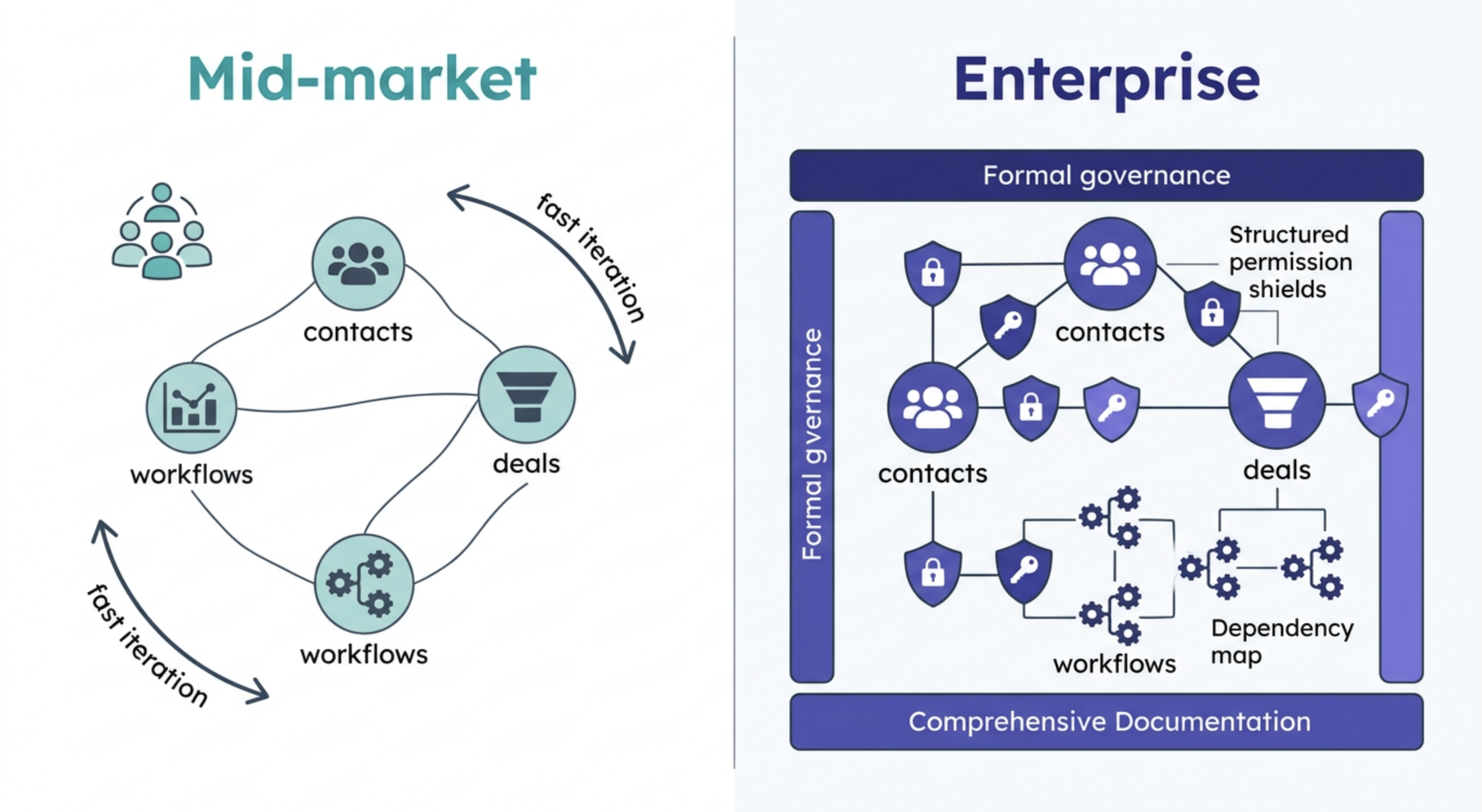
Mid-market HubSpot is optimised for speed and flexibility. Configuration decisions are made quickly, iterated frequently, and owned by a small team that can hold the full system in their heads. The priority is producing commercial results fast — getting pipeline flowing, marketing automation running, and attribution working — without over-engineering a system that may need to change significantly as the business evolves.
Enterprise HubSpot is optimised for reliability and governance. Configuration decisions are made deliberately, documented thoroughly, and owned by a team with defined specialisations. The priority is maintaining data integrity, system trust, and operational continuity at scale — because a broken workflow or a dirty data model at enterprise scale does not affect a dozen users. It affects hundreds, and the cost of remediation compounds with every day the problem persists.
The most expensive HubSpot architecture mistake: building a mid-market system and adding enterprise volume to it without evolving the architecture. The system does not fail suddenly — it degrades gradually. Pipeline reports become less trustworthy. Workflow conflicts multiply. Admin time consumed by cleanup exceeds admin time consumed by building. By the time leadership notices the problem, the debt is 18 months deep and the remediation is a full rebuild.
The head-to-head: architecture patterns across 8 dimensions
| Dimension | Mid-market pattern | Enterprise pattern |
|---|---|---|
| Data model | Native objects (Contact, Company, Deal, Ticket) sufficient for most use cases. Custom objects introduced as specific business needs emerge. Properties created as needed — governance informal. | Custom objects designed upfront for business-specific entities. Property governance enforced via naming conventions, ownership assignments, and change request process. Data dictionary documented externally. |
| Pipeline architecture | 1–3 pipelines covering the primary revenue motion. Stage definitions exist but are not formally enforced — reps advance deals based on their judgement of the criteria. | Multiple pipelines per team and business unit. Stage advancement requires required field completion enforced by workflow validation. Deal stage definitions are documented, reviewed quarterly, and signed off by Sales leadership. |
| User access and permissions | Most users have broad access. Admin rights granted generously to avoid bottlenecks. Property and object visibility ungoverned. | Role-based access matrix documented and enforced. Super admin access restricted to named individuals. Property visibility configured by team and function. Object-level permissions reviewed quarterly. |
| Workflow governance | Workflows built by anyone with admin access. Naming conventions informal or absent. Workflow registry not maintained. Paused workflows accumulate without review. | Workflow naming convention enforced. External workflow registry maintained with owner, trigger, purpose, and last-reviewed date. Quarterly workflow audit mandatory. New workflows require approval from RevOps lead before activation. |
| Integration architecture | Integrations added as tools are adopted. Field mapping informal. Conflict resolution undefined. Sync errors monitored reactively. | Integration architecture documented with field mapping spec, master record rules, sync frequency, and error alerting. Each integration has an owner responsible for monitoring. Change control process for integration modifications. |
| Reporting infrastructure | Dashboards built by individuals for their own use. Multiple versions of the same report exist across teams. No shared reporting standard. Leadership reviews different numbers from different views. | Shared reporting standard documented. One authoritative dashboard per audience tier (exec, RevOps, team-level). Report ownership assigned. Custom report builder used for cross-object reporting. BI tool integration for advanced analysis. |
| RevOps team structure | 1–2 generalist RevOps resources manage the full HubSpot stack. Deep knowledge held in individuals rather than documentation. | Specialised RevOps functions: Marketing Ops, Sales Ops, CS Ops, and a HubSpot architect overseeing the data model and integration layer. Knowledge documented in runbooks accessible to the full team. |
| Change management | Platform changes deployed as needed. User communication informal. Impact assessment minimal — broken workflows discovered by users rather than before release. | Change management process for all platform modifications above a defined impact threshold. Pre-deployment testing environment or sandbox used for significant changes. User communication structured and timed before changes go live. |
Data model: where the divergence starts
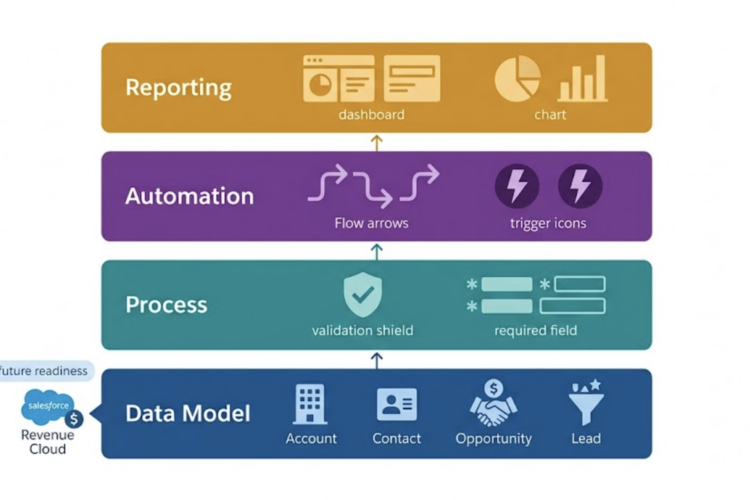
The data model is where mid-market and enterprise HubSpot patterns diverge earliest and most consequentially. A mid-market data model grows organically — properties are added when someone needs them, objects are used in ways that were not their original intent, and the model reflects the history of the business's needs more than a deliberate architecture.
An enterprise data model is designed before it is built. The questions answered before a single property is created:
- What objects does our business actually need, and which of those map to HubSpot's native objects versus requiring custom objects?
- What is the canonical identifier for each object type — the property that uniquely and permanently identifies a record across all systems?
- What properties are required for a record to be operationally complete — and at what stage in the lifecycle must each property be populated?
- What associations exist between objects, what is their cardinality, and what do the associations mean in business terms?
The enterprise data model principle that mid-market companies most often skip: every property must have a defined owner before it is created. Not "the RevOps team" — a named individual whose job function includes responsibility for that property's accuracy and completeness. A property without a named owner is a property that will be populated inconsistently and will degrade within two quarters of go-live.
Governance: the enterprise non-negotiable
Governance is the operational practice of maintaining a HubSpot system's integrity over time — preventing data degradation, preventing automation sprawl, and ensuring that the system remains trustworthy as the organisation using it grows and evolves. In a mid-market implementation, governance is often informal — one or two knowledgeable people apply consistent standards without needing to document them. At enterprise scale, informal governance is not governance at all. It is a person-dependent bottleneck.
The enterprise governance framework minimum viable structure
Every object, property, and association documented with: purpose,
owner, population method, required status, and last-reviewed date.
Lives outside HubSpot — in Notion, Confluence, or equivalent.
2. Property naming convention
Enforced format: [Team]_[Object]_[Name]_[Type]
Example: MKT_Contact_LeadScore_Number
No properties created without following convention — enforced by
RevOps lead approval before creation.
3. Workflow registry
External spreadsheet or doc listing: workflow name, owner, trigger,
purpose, creation date, last-reviewed date, active/paused status.
Quarterly audit: any paused workflow without a documented reason
is deleted. Any active workflow without a current owner is reviewed.
4. Access matrix
Role-based permission documentation: what each role can view,
edit, and delete. Reviewed when roles change. Super admin list
reviewed quarterly — minimum necessary access principle applied.
5. Change control process
Any modification to: data model, active high-volume workflows,
integration field mapping, or reporting standards requires:
impact assessment → RevOps lead approval → staging test → release.
Automation architecture at scale
Automation in a mid-market HubSpot portal typically consists of twenty to fifty active workflows — manageable by a small team, debuggable when something breaks, and rarely creating the complex enrollment conflicts that emerge at enterprise scale. At enterprise scale, automation architectures routinely involve one hundred to three hundred active workflows across multiple hubs, multiple teams, and multiple business processes.
At this scale, the automation architecture must be deliberate in three ways that mid-market implementations typically are not:
Centralised automation logic vs distributed automation
Mid-market automation is typically distributed — each team builds workflows for their own needs independently. Enterprise automation requires centralised logic for cross-functional processes. A lifecycle stage change workflow, for example, must be owned by one team (RevOps) and managed as a single authoritative system — not duplicated by Marketing and Sales each running their own version that conflict with each other under specific conditions.
Workflow dependency mapping
At enterprise scale, workflows trigger other workflows. A lead scoring update triggers a lifecycle stage change, which triggers a lead routing workflow, which triggers a notification workflow. When any of these break, the cascade fails silently unless the dependency chain is documented. Enterprise automation architecture requires explicit dependency maps — drawn and maintained externally — that document which workflows depend on the outputs of other workflows.
Error monitoring and alerting
Mid-market teams discover workflow failures when users complain. Enterprise teams discover workflow failures through automated monitoring — error rate dashboards in HubSpot's workflow performance views, supplemented by Operations Hub alerts when error rates exceed defined thresholds. A workflow that is failing silently on 15% of enrollments in a mid-market portal is a nuisance. In an enterprise portal enrolling thousands of contacts per day, it is a data crisis.
Reporting and intelligence patterns
The reporting architecture gap between mid-market and enterprise HubSpot is one of the most practically significant differences for RevOps practitioners. Both can produce the same reports. The difference is in how those reports are governed, who uses them, and whether they produce shared understanding or competing interpretations.
| Reporting dimension | Mid-market pattern | Enterprise pattern |
|---|---|---|
| Report ownership | Reports built by whoever needs them. Multiple versions of pipeline reports exist across Sales, Marketing, and Finance with different filters and different numbers. | Named report owner for every dashboard in leadership use. One authoritative version per metric. Divergent reports investigated and resolved — not tolerated as "different views of the data." |
| Attribution model | Default attribution model used without deliberate selection. Often first-touch or last-touch because they were the default — not because they reflect the GTM motion. | Attribution model deliberately selected, documented, and agreed across Marketing and Sales. Reviewed annually. Alternative models run in parallel for diagnostic purposes only. |
| Forecasting | Pipeline reports used as a proxy for forecasting. Deal amounts in pipeline summed to produce a forecast number that sales managers then adjust manually based on their knowledge of individual deals. | Forecast categories used in HubSpot with defined criteria per category. AI-assisted forecasting supplemented by manager judgement on flagged deals. Forecast accuracy tracked quarter-over-quarter as a RevOps performance metric. |
| Cross-functional alignment | Marketing and Sales review different dashboards in separate meetings. Numbers are reconciled in conversation when they conflict. | Shared dashboard reviewed in a joint weekly pipeline meeting. Divergence between Marketing and Sales pipeline numbers triggers immediate investigation, not a meeting agenda item. |
The signals that tell you it's time to upgrade your architecture
The transition from mid-market to enterprise HubSpot architecture is not triggered by a plan tier change or a headcount milestone. It is triggered by specific operational signals — early warning indicators that the current architecture is approaching its capacity limits.
The most important signal of all: when the answer to "why does this property exist?" is "I don't know, it was here when I joined" — the system has passed the point where informal governance is sustainable. That question, asked about more than 20% of active properties, is a reliable indicator that a data model audit and governance framework implementation is overdue.
The upgrade sequence: how to evolve without breaking what works
Moving from a mid-market HubSpot architecture to an enterprise one is not a rebuild — it is a structured evolution. The sequence matters: attempting to implement enterprise governance on top of an undocumented system produces governance documents that are wrong from day one because the system they describe was never fully understood.
- Audit first, document second, govern third. Before writing a governance framework, complete a full audit of the current state: every property, every workflow, every integration, every dashboard. Only document what actually exists — not what you think exists or what should exist.
- Stabilise the data model before adding governance. Remove unused properties. Merge duplicate properties. Resolve naming inconsistencies. The data dictionary should describe a clean model — not a historical one.
- Implement governance in layers, not all at once. Start with the highest-impact governance controls: property naming convention, workflow registry, and access matrix. These three alone prevent the majority of governance failures. Add change control, data quality monitoring, and quarterly audit processes in subsequent quarters.
- Build the reporting standard before the dashboards. Agree on metric definitions and authoritative data sources before rebuilding any dashboard. A dashboard built on agreed definitions is maintainable. One built before the definitions are agreed will need to be rebuilt after the first leadership dispute.
- Transition governance ownership deliberately. Identify who will own the governance framework long-term — a named RevOps lead with documented responsibilities. Governance without ownership is documentation without action. The framework must have a human being accountable for its maintenance.
The evolution from mid-market to enterprise HubSpot architecture is not a one-time project. It is a practice — a set of habits and processes that the RevOps team applies consistently over time. The companies that execute this transition well are not the ones that launched the biggest rebuild project. They are the ones that built governance into their operating rhythm before they needed it — and maintained it rigorously after the immediate pressure passed.
→The data model and governance principles described throughout this blog are built on the foundations in Article: Designing a scalable RevOps architecture in HubSpot for enterprise growth.