
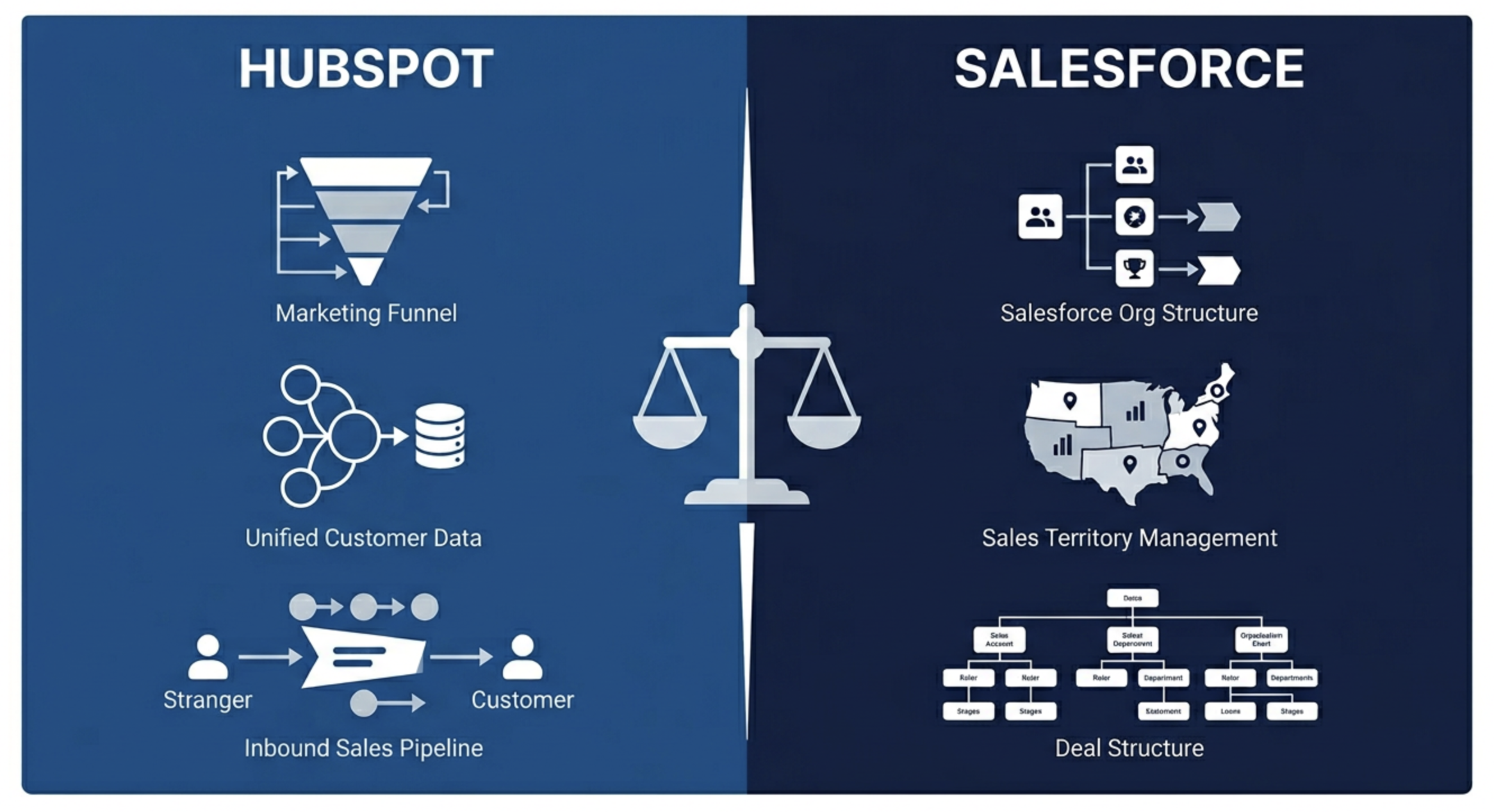
Most HubSpot vs Salesforce comparisons are written by vendors, affiliates, or marketers with a commercial interest in the outcome. This is not that. This is a framework for mid-market companies — those between $5M and $150M in revenue — to make an informed, defensible decision based on their specific go-to-market motion, team structure, and RevOps maturity.
- Why the comparison is more nuanced than most guides suggest
- The head-to-head: 10 dimensions that actually matter
- Where HubSpot wins clearly
- Where Salesforce wins clearly
- The decision scenarios: 6 company profiles with a recommendation for each
- Total cost of ownership: what the pricing pages don't tell you
- The migration question: what it actually costs to switch
- The question nobody asks, but should
Why the comparison is more nuanced than most guides suggest
The HubSpot vs Salesforce debate is often framed as simple: HubSpot for smaller companies, Salesforce for enterprise. This framing is outdated, reductive, and responsible for a significant number of wrong platform decisions made by mid-market companies every year.
HubSpot has invested heavily in enterprise capability — custom objects, advanced permissions, Business Units, predictive lead scoring, and a native Operations Hub that gives it programmable automation without third-party middleware. Salesforce has invested in accessibility — Salesforce Starter, simplified setup flows, and a partner ecosystem that makes basic implementations faster than they were five years ago.
The honest reality for mid-market companies: both platforms are capable of running your revenue operation. The decision is not about capability — it is about fit. Specifically, fit with your go-to-market motion, your team's technical depth, your integration requirements, and your RevOps maturity. Get the fit question right and either platform can serve you well. Get it wrong and you will spend the next eighteen months working around the platform's limitations rather than building on its strengths.
The single most common mid-market platform decision mistake: choosing Salesforce because it is what the new VP of Sales used at their previous company. Platform familiarity is a real consideration — it affects adoption speed and reduces training cost. But it is not a RevOps architecture decision. A platform chosen for familiarity without a structured evaluation of fit will create technical debt the moment the company's go-to-market motion evolves.
The head-to-head: 10 dimensions that actually matter
| Dimension | HubSpot | Salesforce |
|---|---|---|
| Time to value | HS WINS Weeks to a working implementation. Native tools require minimal configuration to produce usable results. Non-technical admins can manage most of the platform. | Months to a working implementation. Even Sales Cloud requires significant configuration. Enterprise deployments routinely take 6–12 months before the organisation is fully operational. |
| Marketing + CRM unification | HS WINS Marketing Hub and CRM share a native data model. Attribution, lifecycle management, and nurture automation are natively connected. No integration required between marketing and sales data. | Marketing Cloud is a separate product with a separate data model from Sales Cloud. Integration between the two is achievable but requires significant configuration — Marketing Cloud Connect — and introduces sync complexity and lag. |
| Reporting and dashboards | CLOSE Native reporting builder is strong for most use cases. Complex multi-object reports require the custom report builder. Cannot match Salesforce's reporting depth without a BI layer. | SF WINS Report builder is more powerful and more flexible. Salesforce reports can join more objects and apply more complex filters natively. Einstein Analytics adds AI-assisted reporting for enterprise. |
| Customisation depth | Custom objects, custom properties, association labels, and Operations Hub coded actions cover most mid-market customisation needs. Ceiling is lower than Salesforce — complex custom logic requires Operations Hub JavaScript, not native config. | SF WINS Apex code, Flow builder, Lightning components, and a fully programmable platform. No practical ceiling on customisation — but every level of customisation adds implementation cost and ongoing maintenance burden. |
| Admin complexity | HS WINS A non-developer admin can manage most of HubSpot's capability. Operations Hub coded actions are the exception. Most mid-market companies can run HubSpot with one dedicated RevOps resource. | Salesforce admin is a career in itself. Even a basic Salesforce implementation requires a certified administrator. Complex implementations require developers. Ongoing maintenance burden is significantly higher than HubSpot. |
| Integration ecosystem | Strong native integration library. Operations Hub data sync covers most common tools. API is well-documented. Gaps: fewer pre-built connectors for enterprise ERP and legacy financial systems. | SF WINS AppExchange has 7,000+ integrations. MuleSoft integration platform for complex enterprise data flows. Salesforce has deeper pre-built connectors to SAP, Oracle, and legacy enterprise systems that matter in enterprise and regulated industries. |
| Service and CS functionality | HS WINS Service Hub is a fully native product. Tickets, knowledge base, customer portal, and SLA management are included. No separate product or integration required. CS and Sales share the same contact and company data natively. | Service Cloud is a separate product from Sales Cloud. Powerful functionality but requires separate licensing and integration between Sales and Service data. TCO increases materially when both are required. |
| RevOps as a function | HS WINS Operations Hub was built specifically for RevOps — data sync, data quality automation, and programmable workflows in one product. HubSpot's philosophy aligns with RevOps as a function, not three separate ops teams. | RevOps in Salesforce requires assembling multiple products: Sales Cloud, Marketing Cloud Connect, Service Cloud, and potentially Revenue Cloud. Each adds complexity and licensing cost. The RevOps vision is achievable but not native. |
| AI and intelligence | HubSpot AI (Breeze) provides content generation, predictive lead scoring, and conversation intelligence. Maturing capability — competitive for mid-market but not enterprise AI depth yet. | SF WINS Einstein AI is more mature, more deeply integrated across the platform, and more extensible. Agentforce adds autonomous AI agents for sales and service workflows. The AI advantage is meaningful for enterprise but often over-specified for mid-market. |
| Pricing predictability | HS WINS Transparent pricing. Contact-based model is predictable as the database grows. Enterprise pricing is high but calculable. No hidden implementation costs built into the product model. | Pricing is opaque without a sales conversation. Per-user licensing scales unpredictably. Implementation partners charge separately. The gap between list price and total cost of ownership is larger than HubSpot — and the gap widens with complexity. |
Where Salesforce wins clearly
Salesforce advantageComplex enterprise sales processesHighly customised deal processes — multiple approval stages, complex quoting with CPQ, territory management across hundreds of reps, multi-currency across dozens of markets — require Salesforce's customisation depth. HubSpot reaches its ceiling before these requirements are satisfied.Salesforce advantageDeep ERP and legacy system integrationCompanies running SAP, Oracle ERP, or complex financial systems with bidirectional data requirements need Salesforce's enterprise integration infrastructure — MuleSoft, AppExchange connectors, and Apex-based custom integrations that HubSpot's API, while capable, does not match in depth.Salesforce advantageRegulated industries with complex compliance requirementsFinancial services with complex FCA requirements, healthcare with deep EHR integration needs, and government or public sector organisations with specific data residency and security requirements often find Salesforce's compliance infrastructure — Shield, Government Cloud, advanced encryption — more mature than HubSpot's equivalent offerings.Salesforce advantageLarge, geographically distributed sales teamsTerritory management, complex role hierarchies, advanced forecasting across large teams, and the reporting depth needed to manage hundreds of sales reps across multiple regions or business units are areas where Salesforce's maturity is a genuine advantage over HubSpot's current capability.
Where Salesforce wins clearly
The decision scenarios: 6 company profiles with a recommendation
Total cost of ownership: what the pricing pages don't tell you
The sticker price comparison between HubSpot and Salesforce is consistently misleading — not because either vendor is dishonest about pricing, but because the total cost of ownership extends well beyond the subscription fee.
| Cost component | HubSpot (Enterprise) | Salesforce (Enterprise) |
|---|---|---|
| Platform subscription | $4,000–$12,000/month depending on tier and contact volume | $150–$300+ per user/month — 35 users = $5,250–$10,500/month for Sales Cloud alone |
| Implementation cost | $15,000–$60,000 for a full RevOps implementation by a certified partner | $50,000–$300,000+ depending on complexity. Enterprise implementations regularly exceed $500,000 all-in |
| Internal admin cost | 0.5–1 FTE RevOps resource can manage most mid-market implementations | 1–3 FTE Salesforce admins required. Developers needed for customisation. Ongoing Salesforce admin salary is $90,000–$130,000+ |
| Training and adoption | Lower — more intuitive UI, faster ramp time for new users. HubSpot Academy resources are free and comprehensive | Higher — Salesforce certification programmes are extensive and expensive. New rep ramp time is materially longer |
| Additional products | Marketing Hub, Service Hub, Operations Hub, CMS Hub priced separately but integrate natively | Marketing Cloud, Service Cloud, Revenue Cloud, Einstein all priced separately with integration complexity between each |
The TCO analysis almost always shows HubSpot as lower total cost of ownership at mid-market scale — not because HubSpot is cheap (it is not), but because the implementation, admin, and integration costs associated with a comparable Salesforce deployment are significantly higher. The break-even point — where Salesforce's deeper capability justifies its higher TCO — typically falls in the $100M–$250M revenue range or at a specific complexity threshold around sales team size, ERP integration depth, or regulatory requirement. Below that threshold, most mid-market companies are paying the Salesforce premium for capability they do not use.
The migration question: what it actually costs to switch
If your company is considering migrating from Salesforce to HubSpot — or vice versa — the migration cost is rarely the largest cost. The largest cost is the disruption to sales operations during the transition, the data quality remediation required before migration, and the adoption programme needed to bring a sales team onto a new platform without a productivity gap.
The realistic migration framework for a mid-market company:
- Data audit first: before any migration begins, audit the source system for data quality. Contact duplicates, incomplete deal records, and orphaned activities must be remediated before they are migrated — importing dirty data into a new system replicates the problems rather than solving them.
- Parallel run period: run both systems simultaneously for 30–60 days with a defined set of records in each. This surfaces integration gaps and adoption issues before the legacy system is decommissioned.
- Migration window: plan for 3–6 months from decision to full go-live for a mid-market migration. Any estimate shorter than this from an implementation partner should be treated with scepticism.
- Adoption programme: a sales team that felt comfortable in the old system will find reasons to revert without a structured adoption programme — role-specific training, champions within the sales team, and adoption metrics tracked in the first 90 days post-migration.
The question nobody asks — but should
Every HubSpot vs Salesforce evaluation focuses on features, pricing, and integration capability. Very few ask the question that most reliably predicts which platform will actually serve the company well over the next three to five years: what is the go-to-market model we are building toward, and which platform was designed to support it?
HubSpot was designed for companies that generate revenue through inbound marketing, content, digital channels, and aligned go-to-market teams. Its architecture reflects that philosophy — everything connects back to the contact, the marketing journey, and the lifecycle.
Salesforce was designed for companies that generate revenue through large, complex, relationship-driven sales processes with many stakeholders, long cycles, and custom commercial terms. Its architecture reflects that philosophy — everything connects back to the deal, the opportunity, and the account hierarchy.
If your revenue model is built around inbound demand generation, product-led growth, or digital-first customer acquisition — HubSpot's architecture is built for you. If your revenue model is built around enterprise account management, complex quoting, and large team territory management — Salesforce's architecture is built for you. The worst outcome is choosing the platform designed for the revenue model you aspire to rather than the one you actually operate. Build the system that serves today's motion and can grow with tomorrow's — not the system that impresses in a demo.
→For the RevOps architecture principles that determine which platform your specific company should build on, see Article: Designing a scalable RevOps architecture in HubSpot for enterprise growth.