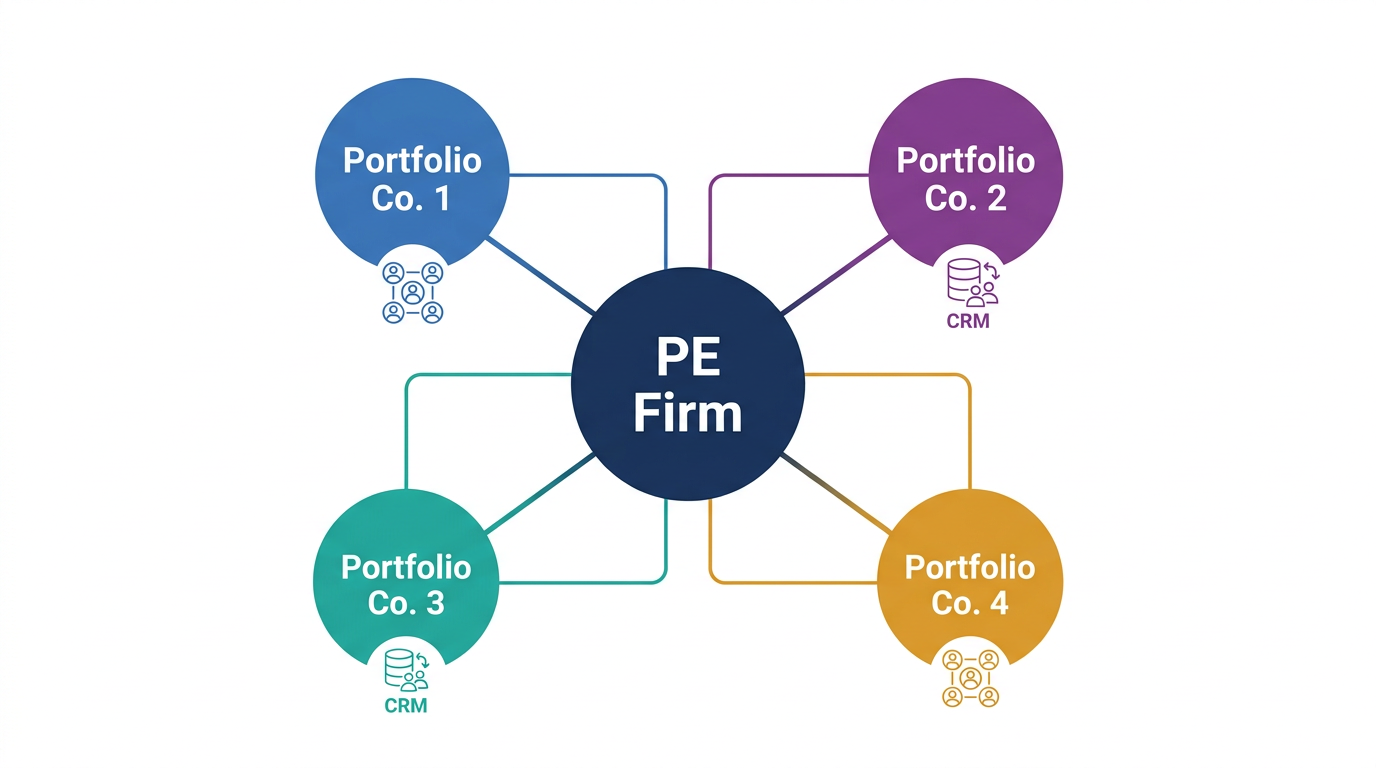
When a private equity firm acquires a company, the 100-day plan covers finance, operations, and people. CRM architecture rarely makes the list. It should. The decisions made — or deferred — in the first 90 days post-acquisition determine whether HubSpot becomes a portfolio-wide revenue intelligence asset or a collection of disconnected, incomparable CRM instances that tell the board nothing useful.
- The post-acquisition CRM problem PE firms don't prioritise
- Three architecture models: separate, federated, unified
- The 90-day post-acquisition HubSpot playbook
- Standardising data definitions across portfolio companies
- The portfolio-level custom object architecture
- Cross-portfolio reporting: what the GP actually needs to see
- Handling add-on acquisitions and CRM consolidation
- When to migrate vs when to integrate
The post-acquisition CRM problem PE firms don't prioritize
A private equity firm acquires a SaaS company in March. By June, the finance team has unified reporting in their portfolio management system. The operating partner has reviewed the leadership team. The capital structure is reset.
The CRM looks exactly as it did on day one of acquisition. The acquired company's HubSpot portal is running the same workflows, the same lifecycle definitions, and the same pipeline stages it had when it was an independent business. Nobody on the deal team thought to ask: does this CRM architecture scale with our value creation thesis, or does it lock in the revenue model we are trying to change?
This is the default post-acquisition CRM state for most PE-backed companies — and it creates compounding problems. By the time the PE firm wants portfolio-level revenue intelligence at month eighteen, each portfolio company is using different lifecycle definitions, different pipeline stages, and different deal metrics. The data cannot be aggregated. Comparisons across portfolio companies are not meaningful. The operational insights the GP needs to make allocation and intervention decisions are simply not available.
The cost of deferring CRM architecture decisions post-acquisition is not linear — it is exponential. Every new workflow built on a non-standard foundation, every new property added without a cross-portfolio naming convention, every quarter of sales data captured in incompatible formats makes eventual standardisation more expensive and more politically difficult. The right time to standardise is in the first 90 days. The second-best time is now.
Three architecture models: separate, federated, unified
Before making any configuration decisions, the PE operating team and each portfolio company's RevOps lead must agree on an architecture model. There are three choices, each with distinct trade-offs.
The federated model is the right choice for the vast majority of PE portfolios. It balances operational autonomy — each company can configure HubSpot to fit its specific go-to-market motion — with the data standardisation required for meaningful cross-portfolio comparison. The investment required to implement the federated model is a defined set of common data definitions, a consistent naming convention, and a reporting integration. It is a weeks-long project, not a months-long one.
The 90-day post-acquisition HubSpot playbook
The 90-day window post-acquisition is when CRM architecture decisions cost the least to make and have the most impact on the portfolio company's revenue trajectory. Here is the sequenced playbook:
1
Days 1–14: CRM audit and architecture assessment
Conduct a structured audit of the acquired company's HubSpot portal: data model, lifecycle definitions, pipeline architecture, active workflows, integration map, and data quality metrics. Produce a written assessment — not a verbal overview — that documents current state against the federated model standard. This audit is the input to every subsequent decision.
Owner: PE operating partner or appointed RevOps consultant
Standardising data definitions across portfolio companies
The single most impactful intervention a PE operating team can make in its portfolio companies' HubSpot portals is enforcing a common data dictionary. Not common workflows, not common dashboards, not common tech stacks — common definitions of the handful of metrics that determine whether portfolio companies are growing at the rate the value creation plan requires.
The minimum viable cross-portfolio data dictionary covers five areas:
| Definition area | What must be standardised | Why it matters for the GP |
|---|---|---|
| Revenue metric | Whether pipeline deals are tracked as ARR, TCV, MRR, or NRR — and how each is calculated and updated when a deal changes | Portfolio revenue aggregation is meaningless if Company A tracks TCV and Company B tracks ARR. The GP cannot compare pipeline health across companies. |
| Pipeline stage names | Equivalent stages across different companies must carry the same name — even if the underlying process differs. "Proposal Sent" means the same commercial milestone regardless of industry. | Enables cross-portfolio pipeline reporting at each stage and identification of which companies have the best conversion rates at specific pipeline stages. |
| Win rate definition | Whether closed-lost includes only formally rejected deals or also includes stalled deals past a defined age threshold | A portfolio company reporting 60% win rate using a narrow definition is not comparable to one reporting 40% using a broader definition. |
| Lead source taxonomy | The categories used to classify how new leads enter the pipeline — inbound, outbound, partner, event, referral, paid — must be identical across all portals | Enables cross-portfolio channel performance benchmarking — which acquisition channels are most efficient across the portfolio? |
| Customer definition | The precise HubSpot lifecycle stage transition that designates a contact or company as a customer — and whether it is triggered by contract signature, first payment, or onboarding completion | NRR and churn calculations depend entirely on when a contact becomes a customer. Inconsistent definitions produce incomparable retention metrics. |
The portfolio-level custom object architecture
For PE firms that want deeper cross-portfolio intelligence beyond pipeline reporting, a custom object architecture at the portfolio company level — standardised across all companies — enables a class of analysis that is not possible with native HubSpot objects alone.
→For the full custom object design framework including association architecture, see Article: HubSpot custom objects & associations — advanced data modeling for complex businesses.
Cross-portfolio reporting: what the GP actually needs to see
Portfolio company management teams produce monthly board packs. Operating partners review individual company dashboards. But the GP-level view — the aggregated revenue picture across all portfolio companies — is almost never available directly from HubSpot without a bespoke reporting layer.
The GP reporting requirements that drive the cross-portfolio HubSpot architecture are typically:
These three metrics require the common data definitions established in Section 4 to be consistently applied across all portfolio companies. Without consistent definitions, the aggregation produces numbers that are statistically valid but analytically meaningless — the GP equivalent of adding apples to oranges and calling the result a fruit count.
Handling add-on acquisitions and CRM consolidation
Buy-and-build strategies create a specific HubSpot challenge: a platform company running a mature HubSpot portal acquires an add-on that has its own CRM — which may or may not be HubSpot. The consolidation decision is one of the highest-stakes CRM architecture choices in the PE-backed company lifecycle.
The decision framework for CRM consolidation post-add-on acquisition:
- If the add-on is small (under 20 sales team members) and the platform company's HubSpot is well-governed: migrate the add-on's data into the platform company's HubSpot portal. Assign a dedicated migration project with a defined data mapping specification, a data quality audit, and a parallel-run period of at least 30 days before the add-on's legacy system is decommissioned.
- If the add-on has a mature, well-configured CRM with significant institutional data: run a federated model for 6–12 months while the integration is designed properly. A rushed migration is more expensive than a deliberate federation — the data lost or corrupted in a poorly executed migration is rarely recoverable.
- If the add-on is in a different market or business model: federate indefinitely with shared reporting standards. Consolidation is an operational choice, not a strategic necessity.
The most expensive CRM mistake in a buy-and-build strategy is migrating an add-on's data into the platform company's HubSpot under time pressure, without a data mapping specification, because the operating team wants "one system" before the next board meeting. The result is a contaminated platform company CRM — duplicate contacts, broken associations, and corrupted pipeline history — that takes 6–12 months to remediate. Time pressure is not a data architecture argument. It is a risk that must be explicitly accepted and documented if the fast migration route is chosen.
When to migrate vs when to integrate
The migrate-vs-integrate decision is the final architectural choice in the post-acquisition HubSpot playbook, and it is the one most frequently made on the wrong basis — speed or political preference rather than data quality and operational continuity.
| Scenario | Recommendation | Key condition |
|---|---|---|
| Add-on is on HubSpot, same tier or below platform company | Migrate — but only with a full data mapping spec and 60-day migration window | Data quality audit of add-on portal must complete before migration begins |
| Add-on is on Salesforce with 3+ years of clean data | Integrate via HubSpot-Salesforce connector during transition; migrate after 12 months when Salesforce data is less operationally active | Migration should not disrupt live sales operations at the add-on |
| Add-on is on a legacy CRM (Dynamics, Zoho, Sugar) with inconsistent data | Clean and migrate only the records that meet a defined data quality threshold; leave legacy records in an archived export | Do not migrate dirty data — it contaminates the destination portal |
| Add-on has no CRM or uses spreadsheets | Build new in platform company's HubSpot from scratch; import only contact and company records with manual verification | Treat this as a new implementation, not a migration |
| Platform company and add-on are in different geographies with data residency requirements | Maintain separate portals with federated reporting; do not migrate across data residency boundaries without legal confirmation | Confirm data residency requirements with legal counsel before any cross-border data movement |
The migrate-vs-integrate decision should always be made by the people who will live with the consequences — the portfolio company's RevOps lead and sales leadership — not by the PE operating team under time pressure. The operating team sets the strategic objective. The portfolio company team defines the implementation path. When these roles are reversed, data quality suffers and trust in the CRM is damaged at the exact moment the company most needs its revenue infrastructure to be reliable.
→The SSOT principles that govern cross-portfolio data consolidation are established in Article: Building a single source of truth using HubSpot CRM — a technical guide.