

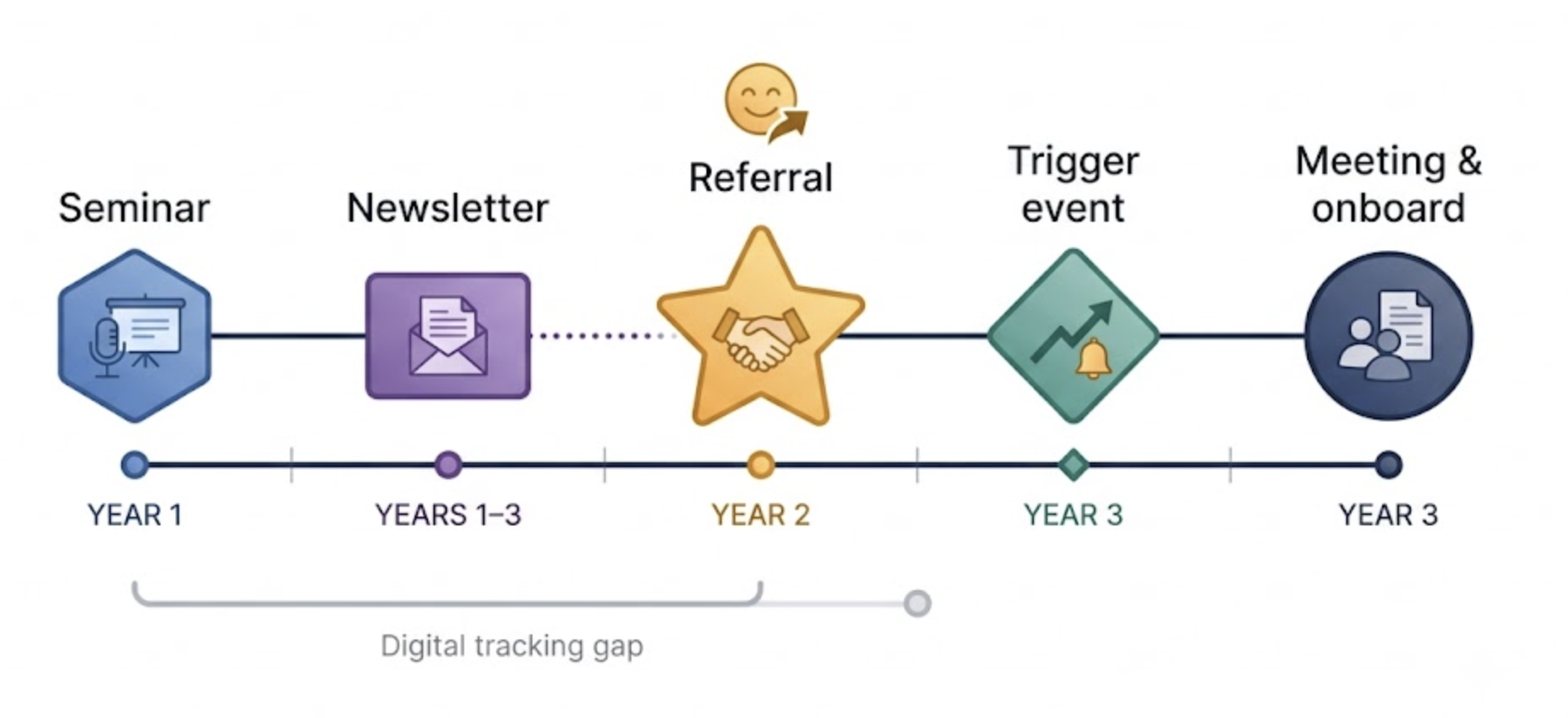
Wealth management firms have some of the longest, most relationship-driven client journeys in any industry. A new client might have attended a seminar three years ago, received a quarterly newsletter for two years, been referred by an existing client, and then called after a market event. Attributing that relationship to a single channel is not just inaccurate — it actively misrepresents how your business develops clients.
- Why standard attribution models fail in wealth management
- The wealth management client journey — mapped for HubSpot
- The referral attribution problem: the most important channel you can't measure
- Choosing the right attribution model for financial advisory cycles
- AUM as the revenue metric — replacing deal value with managed assets
- The HubSpot properties you need to attribute correctly
- Building a dual-model attribution approach
- Attribution reporting for wealth management leadership
Why standard attribution models fail in wealth management
HubSpot's attribution models were designed around relatively short, digitally-trackable buyer journeys. A prospect visits a website, downloads a resource, opens emails, books a demo, and closes within weeks or months. Every touchpoint is digital, logged, and attributable.
Wealth management client acquisition looks nothing like this. The journey from first awareness to signed client often spans one to five years. Many of the highest-value touchpoints — a seminar conversation, a referral over dinner, an introduction at a professional event — are offline and leave no digital trace unless someone deliberately logs them in the CRM. The final conversion trigger is frequently a life event — an inheritance, a business sale, a retirement — that has nothing to do with a marketing campaign.
Applying a standard first-touch or last-touch attribution model to this journey produces conclusions that are not just wrong but potentially harmful to business development strategy. A last-touch model credits the final email before a prospect called — ignoring three years of relationship-building that created the context for that call. A first-touch model credits the seminar registration from four years ago — ignoring the referral from a trusted client that actually prompted the prospect to act.
The danger of wrong attribution in wealth management is not just academic. Firms that trust last-touch attribution data have cut seminar budgets because "digital channels show better ROI," only to watch new client acquisition decline over the following 18 months as the relationship pipeline — which was mostly offline — dried up. Attribution models that don't reflect your actual business development motion don't just mislead — they actively damage it.
The wealth management client journey — mapped for HubSpot
Before configuring attribution in HubSpot, the client journey must be mapped in a way that reflects the actual sequence of touchpoints that lead to a new client relationship — including the offline ones. For most wealth management firms, the journey contains five distinct phases.
The referral attribution problem: the most important channel you can't measure
Referrals are typically the highest-converting and highest-AUM source channel in wealth management. A prospect referred by a trusted existing client arrives with pre-established credibility, lower resistance, and often a larger asset base than a prospect from any other channel. And yet referral attribution in most wealth management HubSpot portals is either missing entirely or captured so inconsistently that it is analytically useless.
The problem is structural. HubSpot's native attribution models track digital touchpoints — form submissions, email clicks, page views. A referral that began with a phone call between two clients leaves no digital trace. If the referred prospect eventually fills out a contact form on your website, HubSpot's last-touch model attributes the new client to "organic search" or "direct" — completely obscuring the referral that actually drove the conversion.
The fix is not a technical one — it is a process one. Referral source must be captured explicitly, by a human, at the point of first contact with a new prospect. This means every new contact record in HubSpot must have a Source Type property set to "Referral" and a Referred By property populated with the contact ID of the referring client before any other activity is logged. Building this into your intake process — as a required field on your new enquiry form or as a mandatory step in your first contact workflow — is the only reliable way to measure referral channel performance.
Referral attribution properties for HubSpot
Source Type (dropdown):
Referral — existing client
Referral — professional introducer
Referral — family / friend
Seminar / event
Digital — organic search
Digital — paid
Digital — content / newsletter
Direct / unknown
Referred By (HubSpot contact lookup):
→ Links to the referring client's Contact record
→ Enables referral network reporting: which clients
refer most, and what is the AUM value of their referrals?
Introducer Firm (text or Company lookup):
→ For professional introducer referrals (accountants,
solicitors, IFAs referring to specialists)
Source Confirmed Date (date):
→ When referral source was verified with the prospect
Choosing the right attribution model for financial advisory cycles
With client journeys spanning years and a dominant offline channel in referrals, no single HubSpot attribution model accurately represents wealth management business development. The practical approach is to run two models in parallel and use each for a different analytical purpose.
→For the full breakdown of all six HubSpot attribution models and how to choose between them, see Article: Revenue attribution models in HubSpot — first-touch, multi-touch & beyond.
AUM as the revenue metric — replacing deal value with managed assets
Standard HubSpot deal reporting uses deal amount as the revenue metric — the value of the transaction being tracked in the pipeline. For wealth management, deal amount is the wrong metric. The revenue relationship with a client is not transactional — it is recurring, based on assets under management that fluctuate with market performance and client behaviour over years or decades.
This means your attribution and pipeline reporting in HubSpot must be rebuilt around AUM rather than deal amount. The practical implications are:
- Pipeline deals should carry estimated AUM rather than a one-time deal value. Estimated AUM at onboarding is the metric that correlates with long-term revenue potential, not the initial advisory fee.
- Closed-won deals should update the Company record's Total AUM property to reflect the assets brought across at onboarding. This property should be synced or manually updated as AUM grows through additional contributions or market performance.
- Attribution reports should segment by AUM band — comparing source type performance not just by client count but by average AUM per client. A channel that produces ten clients at £200K AUM is less valuable than a channel that produces three clients at £2M AUM.
- Lifetime revenue calculation requires AUM × annual fee rate × expected retention years — a calculated property or Operations Hub workflow that produces a comparable lifetime value figure alongside the AUM metric.
HubSpot properties for AUM-based revenue reporting:
Deal properties:
Estimated AUM at onboarding (currency)
Fee basis (dropdown: % of AUM / fixed / hybrid)
Estimated first-year revenue (calculated)
AUM source (dropdown: liquid assets / pension / property / business sale)
Company properties:
Total AUM (currency — updated at onboarding + annually)
AUM band (dropdown: under £250K / £250K–£1M / £1M–£5M / £5M+)
Relationship start date (date)
Estimated lifetime value (calculated: AUM × fee rate × 10)
Referral value generated (calculated from referred contacts' AUM)
The HubSpot properties you need to attribute correctly
Accurate attribution in wealth management requires a property set that captures both the digital touchpoints HubSpot tracks natively and the offline touchpoints that dominate the actual journey. The minimum viable property set for attribution reporting:
| Property | Object | Who populates | Attribution purpose |
|---|---|---|---|
| Source Type | Contact | Relationship manager at first contact | Primary channel classification for all attribution reports |
| Referred By | Contact | RM at first contact | Referral network analysis — which clients generate most AUM through referrals |
| Trigger Event Type | Contact | RM during fact find | Identifies what converted passive awareness to active enquiry — informs BD event strategy |
| First Seminar / Event Attended | Contact | Event management integration or manual | Measures event channel contribution to long-term pipeline |
| Nurture Duration (months) | Contact | Calculated (first contact date to enquiry date) | Shows how long prospects stay in passive pipeline — informs nurture investment decisions |
| Introducer Firm | Contact | RM at first contact | Measures professional introducer channel performance by firm |
| Estimated AUM at onboarding | Deal | RM during proposal stage | Weights attribution by revenue value rather than client count |
Building a dual-model attribution approach
Given the limitations of any single attribution model for wealth management, the most accurate approach is to run two attribution lenses simultaneously in HubSpot and use each for a specific business question.
Attribution reporting for wealth management leadership
Leadership in a wealth management firm does not want a marketing attribution dashboard. They want answers to three business development questions that they currently cannot reliably answer from their CRM data:
These three reports are built as custom HubSpot reports using the properties defined in Sections 5 and 6. They are not available from HubSpot's default reporting library — they require the custom report builder and the property infrastructure described in this guide to be in place first.
The dashboard that contains these three reports — reviewed monthly by the partners or directors responsible for business development — is the most tangible demonstration that HubSpot has been configured to serve a wealth management firm specifically, not just adapted from a generic CRM template.
The test for whether your attribution reporting is working in a wealth management context: can your most senior BD partner, in five minutes, answer the question "which three relationships or activities produced the most new AUM in the last 12 months, and how much?" If HubSpot cannot answer that question clearly and accurately, your attribution architecture needs attention — regardless of how good your marketing attribution dashboard looks.
→This article builds on the CRM governance and data architecture established in Article: HubSpot CRM for financial services — compliance, data governance & pipeline.