
Financial services firms don't fail at HubSpot because the tool is wrong for the industry. They fail because they configure HubSpot like a SaaS company — prioritising speed and automation — when their regulatory environment demands governance and auditability first.
In this article
- Why financial services firms configure HubSpot differently
- The four compliance dimensions that shape your CRM architecture
- Data governance: the financial services non-negotiables
- Communication logging and subscription management
- Audit trails in HubSpot: what logs exist and what they cover
- Pipeline architecture for financial services segments
- Custom objects for financial products and relationships
- The automation boundary: what to automate and what not to
Why financial services firms configure HubSpot differently
HubSpot was designed with a marketing-led, automation-first philosophy. For most industries, this is an advantage. For financial services — wealth management, private equity, investment banking, insurance, and financial advisory — it is a configuration trap.
The instinct when implementing HubSpot in any firm is to build workflows quickly, automate communication sequences, and let the platform generate pipeline activity at scale. In financial services, that instinct must be checked at every step against two questions: is this communication appropriate for regulated client interaction, and does this action leave an auditable record?
This does not mean HubSpot is inappropriate for financial services. It means the implementation priority order is inverted compared to most industries. Where a SaaS company builds automation first and governance second, a financial services firm must build governance first and automation carefully second — if at all in certain areas.
The most common financial services HubSpot failure: a firm implements a standard HubSpot onboarding, launches automated email sequences to prospects, and receives a compliance query six months later because the communication cadence was not approved through the correct review process. The automation was technically functional. It was commercially and regulatorily inappropriate.
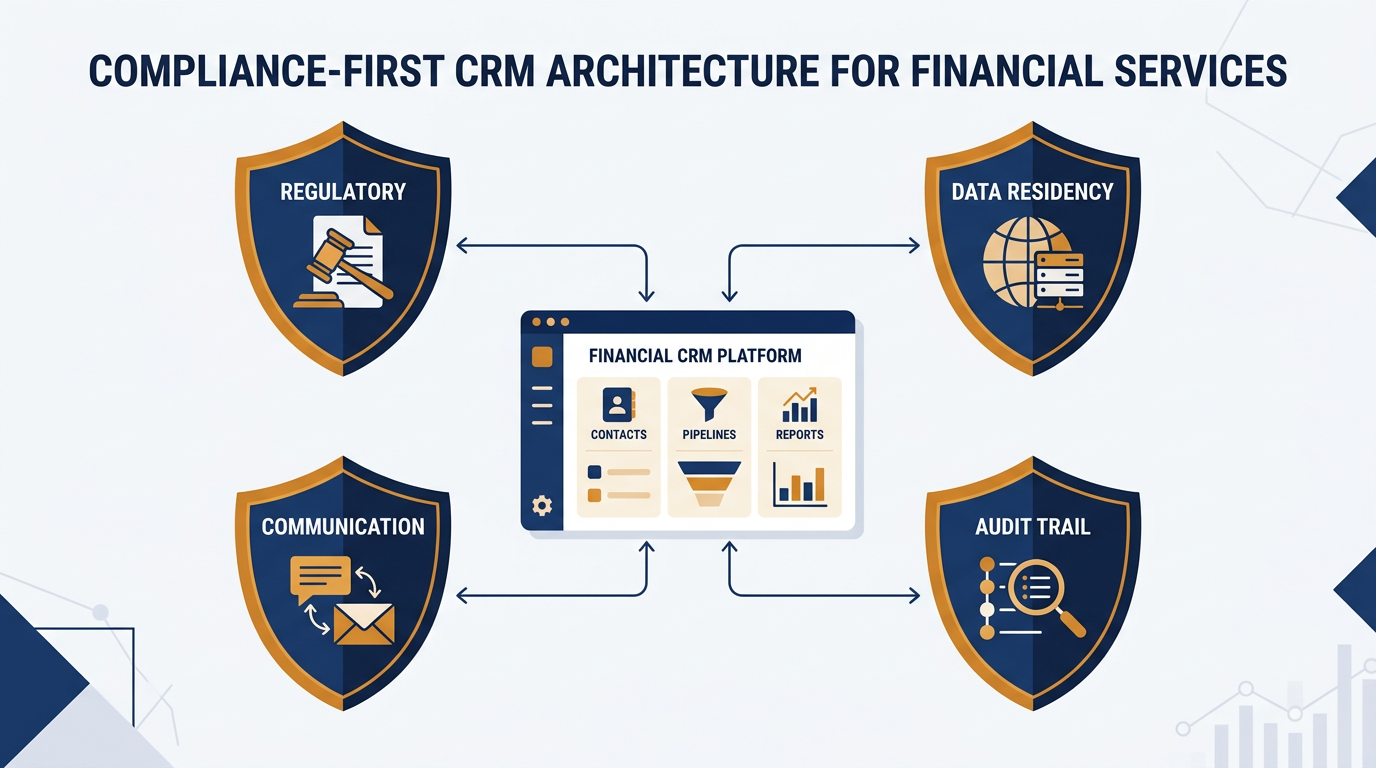
The four compliance dimensions that shape your CRM architecture
Dimension 01 — Regulatory
FCA, SEC, MiFID II, GDPR
Depending on jurisdiction and service type, your CRM configuration must respect conduct rules, suitability requirements, and marketing communication restrictions. FCA-regulated firms in the UK and SEC-registered advisers in the US face particularly specific constraints on how client data is stored, accessed, and used for marketing purposes.
Dimension 02 — Data residency
Where client data lives matters
Many financial services firms — particularly those serving institutional clients or operating across jurisdictions — face data residency requirements specifying that client data must remain within a defined geographic boundary. HubSpot's enterprise data residency options must be confirmed against your specific requirements before go-live, not after.
Dimension 03 — Communication
What you can send and to whom
Financial promotion rules govern what marketing communications can say, who can authorise them, and to whom they can be sent. HubSpot's communication subscription framework must be configured to reflect these rules — including consent capture, opt-out processing, and communication type categorisation that aligns with your compliance team's definitions.
Dimension 04 — Audit trail
Every client interaction must be logged
Regulators may require firms to produce records of client interactions — including emails, calls, meetings, and advice given — on request. HubSpot's activity logging capabilities are strong, but they must be actively configured and tested to ensure the right interactions are captured against the right client records.
Data governance: the financial services non-negotiables
Data governance in financial services HubSpot is not a best practice — it is a baseline requirement. The governance framework must be established before any client data enters the CRM, because retrospectively applying governance to a populated database is exponentially more difficult than building it correctly from the start.
Client identity and deduplication
Financial services firms frequently manage complex client relationships: an individual who is both a personal wealth management client and a director of a corporate client. A family office with multiple individual members all associated to a single entity. HubSpot's standard Contact-to-Company association model handles straightforward relationships well. Complex relationship structures — where a single individual holds multiple distinct roles across multiple entities — require deliberate association architecture using HubSpot's association labels and, in more complex cases, custom objects.
The deduplication challenge in financial services is compounded by the fact that client records often exist in multiple systems — a portfolio management system, a compliance platform, a CRM — before HubSpot is introduced. The integration strategy must resolve identity conflicts across these systems before data is migrated, not after.
Access control and data sensitivity
Not all client data in a financial services HubSpot portal should be accessible to all users. A junior relationship manager should not have visibility of a private equity partner's full deal history. A marketing team member should not be able to view client AUM or portfolio data. HubSpot's role-based access control system — combined with team assignments, property-level permissions, and object visibility settings — provides the controls to enforce these distinctions. Configuring them requires a deliberate access matrix built in collaboration with compliance and HR before the portal goes live.
Financial services access matrix — minimum viable structure:
Super Admin: Full portal access — RevOps / CRM owner only
Sales Admin: Pipeline + contact edit, no financial properties
Relationship Mgr: Own contacts + companies, read-only financial props
Marketing: Campaigns + contact list view, no deal or financial access
Compliance: Read-only full portal + activity log access
Executive: Dashboard + reporting access, no record editing
Communication logging and subscription management
HubSpot's Communication Subscriptions framework is the mechanism by which you track and enforce what types of marketing communication each contact has consented to receive. For financial services firms, this framework must be configured with more precision than most implementations apply — because the consequences of sending an unapproved communication to a regulated client extend beyond a GDPR fine to potential conduct rule breaches.
Subscription type architecture for financial services
Most HubSpot implementations create a handful of generic subscription types — "Marketing emails," "Product updates," "Newsletter." Financial services firms need a more granular subscription architecture that reflects the distinct regulatory treatment of different communication categories:
- Financial promotions: requires FCA-approved or exemption-classified content. Must only be sent to contacts who meet the appropriate investor classification (retail, professional, eligible counterparty) and have provided the relevant consent.
- Service communications: operational updates, reporting, and account-related notifications. Generally lower regulatory burden but must still be logged and auditable.
- Event invitations: client event invitations are often treated separately from marketing communications because they may carry different consent requirements and different audience eligibility criteria.
- Research and insights: if your firm distributes investment research, the distribution list and consent status must be meticulously maintained — research distribution to non-professional investors is tightly regulated in most jurisdictions.
HubSpot's subscription preference centre can be configured to display these distinct subscription types, allowing contacts to manage their own preferences at the category level. For financial services firms, this preference centre is not just a user experience feature — it is a compliance mechanism that must be tested, documented, and reviewed whenever regulatory requirements change.
Email and call logging
HubSpot's native email integration logs emails sent from HubSpot and — via the Gmail or Outlook integration — emails sent and received in connected mailboxes. For financial services compliance purposes, this logging must be verified to be comprehensive: every client-facing email sent by a relationship manager should appear in the contact's activity timeline. Gaps in the email log are potential compliance gaps.
Call logging via HubSpot's calling feature or a connected telephony integration (Aircall, JustCall) captures call records against contact and deal records. For firms subject to MiFID II or equivalent call recording requirements, the integration between HubSpot's call log and your dedicated call recording system must be explicitly designed — HubSpot's call log is a record of that a call occurred, not a recording of its content.
Audit trails in HubSpot: what logs exist and what they cover
HubSpot provides several distinct audit and logging mechanisms. Understanding what each covers — and what it does not — is essential for financial services compliance teams evaluating whether HubSpot meets their record-keeping requirements.
| Log type | What it captures | Retention | Financial services relevance |
|---|---|---|---|
| Activity timeline | Emails, calls, meetings, notes, tasks logged against a contact or deal record | Indefinite | Primary client interaction audit trail. Must be actively maintained by relationship managers. |
| Property history | Every change to a contact or deal property — old value, new value, who changed it, when | Indefinite | Critical for compliance: proves when a client's status, classification, or relationship changed and who made the change. |
| Workflow enrollment history | Which workflows a contact was enrolled in, when, and what actions fired | Indefinite | Proves which automated communications a contact received. Important for financial promotion audit. |
| Portal audit log | Admin actions — user creation, permission changes, workflow edits, integration changes | 180 days (Enterprise) | System governance log. Useful for demonstrating that the CRM configuration meets compliance requirements over time. |
| Email send log | All marketing emails sent, including open/click/unsubscribe data | Per HubSpot retention policy | Financial promotion delivery record. Must be supplemented with export and archiving for long-term retention requirements. |
HubSpot's built-in logs are strong for operational purposes but may not satisfy all financial services record-keeping requirements without supplementary archiving. Firms subject to seven-year or longer record retention obligations — common under MiFID II and FCA rules — must implement an export and archiving strategy for HubSpot data, not rely solely on the platform's native retention. Confirm your retention requirements with your compliance team before go-live.
Pipeline architecture for financial services segments
Financial services is not a monolithic industry. Wealth management, private equity, insurance, and investment banking have fundamentally different pipeline architectures — different deal stages, different timeframes, different handoff structures. HubSpot's pipeline flexibility accommodates all of them, but the architecture must reflect the specific commercial motion of each segment.
→For the foundational pipeline and lifecycle architecture patterns that underpin these segment-specific pipelines, see Article: Building a single source of truth using HubSpot CRM.
Custom objects for financial products and relationships
Standard HubSpot objects — Contact, Company, Deal, Ticket — do not adequately model many financial services relationships. The entities that typically require Custom Objects in a financial services HubSpot portal include:
- Product or mandate object: tracks individual financial products, investment mandates, or advisory engagements — with properties for product type, AUM, mandate date, review cycle, benchmark, and regulatory classification. Associated to Company (the client entity) and to the relationship manager (Contact owner).
- Portfolio object: for wealth management or investment firms, tracks the client's overall portfolio structure — asset allocation, risk profile, last rebalance date, performance reference. Connected to Company and to individual Product records.
- Compliance review object: tracks scheduled and completed compliance reviews — type (annual, ad-hoc, triggered), review date, outcome, reviewer name, and document reference. Provides a structured audit trail that is more queryable than notes on a contact record.
- Entity relationship object: for firms managing complex family office or corporate group structures, tracks the relationships between legal entities — holding company, subsidiaries, beneficial owners — as distinct objects with their own association labels and ownership properties.
→For the full custom object architecture and association design framework, see Article: HubSpot custom objects & associations — advanced data modeling for complex businesses.
The automation boundary: what to automate and what not to
Automation in financial services HubSpot is not prohibited — it is constrained. The distinction between appropriate and inappropriate automation is not always obvious, and it must be drawn in consultation with your compliance team rather than your CRM administrator.
Appropriate automation in financial services HubSpot
- Internal notifications — alerting relationship managers to renewal dates, review deadlines, or compliance review due dates
- Task creation — automatically generating review tasks, follow-up tasks, and documentation reminders when pipeline stages advance
- Data quality — property formatting, deduplication, completeness checks on client records
- Reporting — automated dashboard updates, performance summary reports sent internally
- CRM record updates — lifecycle stage changes, property updates triggered by internal events
Automation requiring compliance pre-approval
- Any automated outbound communication to clients or prospects — emails, SMS, meeting invitations
- Any communication that constitutes or references a financial promotion
- Lead scoring or routing that uses financial product suitability as a criterion
- Automated document generation or distribution that includes client-specific financial information
The test for any automation you are considering deploying in a financial services HubSpot portal: if a regulator reviewed this workflow and its outputs, would every action it takes be defensible under your firm's compliance framework? If the answer is uncertain, the automation should not be deployed until it has been reviewed. The cost of compliance review is a fraction of the cost of a conduct rule breach.